Showing posts with label maitotoxin. Show all posts

Friday, November 7, 2014

Friday Fun - Maitotoxin Watch

For those keeping tabs on K.C. Nicolaou's potential career capstone, the group has published another fragment (QRSTUVWXYZA') of the ladder polyether maitotoxin. By my count (and thanks to their handy graphic, below), they've now formed 30 of the 32 requisite rings, meaning we'll likely see a completed total synthesis in the next few years.*

Top: Maitotoxin
Bottom: Previously disclosed fragments
Source: Nicolaou et.al. | JACS 2014 ASAP

When Nicolaou's group announced the move to Rice, one of my first thoughts was "who gets to personally chaperone the maitotoxin fragments to their new home?" I'm picturing combination-locked black suitcases handcuffed to postdocs' wrists, but perhaps the samples just went in the back of a U-Haul truck with all the other lab equipment.

Happy Friday,
See Arr Oh
--
*Assuming they can work out the ring fusion and selective sulfate chemistry - not trivial tasks by any means!

Thursday, June 27, 2013

Get it Funded! (A Game)

Last night, intrepid C&EN reporter Dr. Dre, err, Dr. Drahl, sent over another challenge from NOS2013:

Let's reword that: How will changes in funding affect total synthesis, the study of assembling complex natural products from simple commercial chemicals?

Now, this isn't the first time folks have declared the synthetic field to be on death's door. Hardly. So, I answered the way I always do, which has kept the field alive and kicking long past Woodward:


Chemjobber, always one for a savvy one-liner, immediately jumped on board:

Nyuk nyuk nyuk. OK, wise guy, I've got a few more, then . . .

"Reversible carbon dioxide capture using lycopodium alkaloid analogs"

"Pentacene-functionalized steroids for solar panels"

"Origin of Life: The Gliotoxin Hypothesis"

"Analysis of 10^5 novel secondary metabolites in the human gut microbiome"

OK, Readers, I'm sure you can do better. Leave me some gut-shakers and knee-slappers in the comments section!

Thursday, April 25, 2013

Throwing Down for #RealTimeChem Week

Carmen and Stu have been free-hand drawing some fancy stuff on Twitter to celebrate #RealTimeChem week. I thought I'd add in my two cents:

Behold, maitotoxin!
P.S. I totally cheated, and glanced at a paper to do this. There's no WAY I'm memorizing that!

Monday, April 2, 2012

Press Release Supplement

As part of my new editorial gig over at Nature Cooking, I've had sit-downs with all the major factions in the company, including the fine folks over at Nature Protocols. They were kind enough to suggest a theme for our first issue; apparently, that's chemistry cookies!
Credit: Nature Protocols, via "The Twitter"
In an attempt to please my new colleagues, I scoured the Electrical Highway for at least 5 minutes, until I found these critical lab instruments:
Scientific Cookie Cutters | Credit: thinkgeek.com
Oddly, the strychnine and maitotoxin shapes were on back order....c'est la vie.

Thursday, March 1, 2012

This Just In - File Under "Huge Marine Polyethers"


K. brevisculata
Source: Te Ara - Encyclopedia of New Zealand
Maggy Wassilieff
There's a new red tide in town: Karenia brevisulcata, a dinoflagellate first discovered in New Zealand in 1998. This ocean denizen was pegged for a wave of fish kills and human illnesses, which cued curious natural products chemists to have a peek at their toxin profile. The scientists noted that several of the cell extracts had molecular masses well above 2000 - large polyether territory - and were lethal to lab mice.


Et voilà! Say hello to brevisulcenal-F, their first solved structure from the algal cells. This toxin, tipping the scales at 2076 amu (M + Na), sets a record in its own right: it has seventeen contiguous 6- and 7-membered rings, A-Q, the most yet identified in a single marine ladder toxin (I can almost hear Mori, Nicolaou, Hirama, and Crimmins sharpening their swords, ready for action!).
Brevisulcenal-F spectrum and structure overlay
Source: JACS and M. Satake, U. of Tokyo


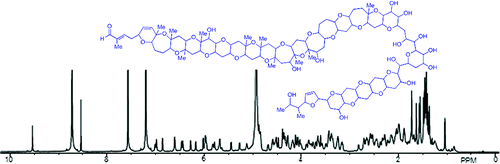
But how big is big? This new natural product certainly contends, but still doesn't approach two of the 850-lb gorillas in the room: palytoxin (PTX) and maitotoxin (MTX). First synthesized from PTX-COOH by Kishi in 1994, palytoxin, a soft-coral isolate from Hawaii, weighs in at 2680 amu. Although not specifically a ladder polyether, it was for decades considered the largest known non-peptide natural product. But PTX pales still in comparison to the largest known non-peptide np, maitotoxin, which totals 3422 amu, with 32 total ether rings. Isolated from Tahitian fish in 1976, maitotoxin eluded full structural characterization until the mid-1990s.
I'm glad my NMRs don't look like maitotoxin.
Source: Murata, JACS 1994


Where are these huge marine toxins coming from, exactly? Nakanishi advanced a polyepoxide cascade theory as early as 1985, which suggested that long, polyunsaturated terpenes (olefin biopolymers) were being somehow oxidized by the microorganisms, then cyclized into long ether "ladders," like a falling stack of dominos. It took another 20 years for experimental confirmation, but new cascade research by Jamison and others has shown that this might indeed be the case.