Showing posts with label New Zealand. Show all posts

Thursday, March 29, 2012

LFTB - Not Just Meat (Thanks, Internet!)

The Luning-Fencemaker Belt
Looks like you drive out of Reno on US80, then hike in...
Credit: University of GA Geology Dept.
Over at Sci Am blogs, I've recently written a post about LFTB, the processed meat product some call safe and others call "slime." When I first heard read the acronym, I thought it would be a snap to find information, since that can't stand for too many other things...right?

LFTB means:


An Airport in Southern France - Marginane looks like a quaint little place to visit! This designation "LFTB," an ICAO code, helps direct air-traffic controllers.

A Geological Formation - The Luning-Fencemaker Fold-Thrust Belt, a twist of rock in Nevada. Apparently, you can date rocks and determine geological events using argon isotope data. The More You Know (TM), I guess.

Early Biofuels Research? - A now-defunct New Zealand-based organization, the Liquid Fuels Trust Board, seemed to be among the early pioneers in developing waste-derived fuels and methanol-powered vehicles.


An Anti-Litter Campaign - Thunder Bay, ON, Canada, would like to remind you to keep their community spotless, and wants to instill a "litter consciousness" in its townsfolk. Bonus Geographical Moment: Thunder Bay sits on Lake Superior, right across from Isle Royale and Pie Island. Sounds beautiful.

Flight School: Want to Drive an Airbus? Lufthansa, the German airline, operates 11 flight simulators at  a facility in Berlin, which can teach pilots to fly all the big craft, from Boeing 777s to Airbus A320-200s.


Thursday, March 1, 2012

This Just In - File Under "Huge Marine Polyethers"


K. brevisculata
Source: Te Ara - Encyclopedia of New Zealand
Maggy Wassilieff
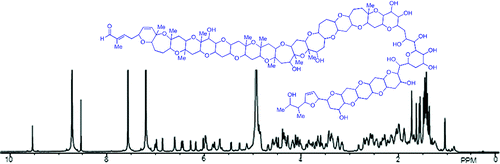
There's a new red tide in town: Karenia brevisulcata, a dinoflagellate first discovered in New Zealand in 1998. This ocean denizen was pegged for a wave of fish kills and human illnesses, which cued curious natural products chemists to have a peek at their toxin profile. The scientists noted that several of the cell extracts had molecular masses well above 2000 - large polyether territory - and were lethal to lab mice.


Et voilà! Say hello to brevisulcenal-F, their first solved structure from the algal cells. This toxin, tipping the scales at 2076 amu (M + Na), sets a record in its own right: it has seventeen contiguous 6- and 7-membered rings, A-Q, the most yet identified in a single marine ladder toxin (I can almost hear Mori, Nicolaou, Hirama, and Crimmins sharpening their swords, ready for action!).
Brevisulcenal-F spectrum and structure overlay
Source: JACS and M. Satake, U. of Tokyo


But how big is big? This new natural product certainly contends, but still doesn't approach two of the 850-lb gorillas in the room: palytoxin (PTX) and maitotoxin (MTX). First synthesized from PTX-COOH by Kishi in 1994, palytoxin, a soft-coral isolate from Hawaii, weighs in at 2680 amu. Although not specifically a ladder polyether, it was for decades considered the largest known non-peptide natural product. But PTX pales still in comparison to the largest known non-peptide np, maitotoxin, which totals 3422 amu, with 32 total ether rings. Isolated from Tahitian fish in 1976, maitotoxin eluded full structural characterization until the mid-1990s.
I'm glad my NMRs don't look like maitotoxin.
Source: Murata, JACS 1994


Where are these huge marine toxins coming from, exactly? Nakanishi advanced a polyepoxide cascade theory as early as 1985, which suggested that long, polyunsaturated terpenes (olefin biopolymers) were being somehow oxidized by the microorganisms, then cyclized into long ether "ladders," like a falling stack of dominos. It took another 20 years for experimental confirmation, but new cascade research by Jamison and others has shown that this might indeed be the case.