Showing posts with label antibiotics. Show all posts

Wednesday, December 31, 2014

2015 JLC New Year's Resolutions

And so we close another year on the chemblogosphere. Instead of recounting the highs and lows of 2014, I've decided this year to focus on what lies ahead for Just Like Cooking.

A goofy, fitting send-off to 2014,
courtesy of the San Fran ACS Meeting
Three areas I'll try to focus on for 2015:

1. Photocatalysis. It's exploding in all areas of chemistry, with new complexes and new (old) dyes appearing daily. Hopefully 2015 will show more light-promoted reactions as key steps in total syntheses.

2. Antibiotic Development. Dire predictions swirl around our readiness, as a species, to defend ourselves against the ever-evolving horde of microorganisms surrounding us. Hopefully 2015 - whether by luck or skill - finds new molecules to address this challenge.

3. Alternative Careers / Leaving the Lab. (Refer to my apologia from a few weeks ago...)


Wishing you and yours a happy, healthy start to 2015!
See Arr Oh

Thursday, May 22, 2014

Antibiotic Purple Rain

Did you know scientists used Clostridium species to produce industrial solvents from cellulose?
Did you know anaerobic (oxygen-free) bacteria produced polyketides?
(I didn't!)

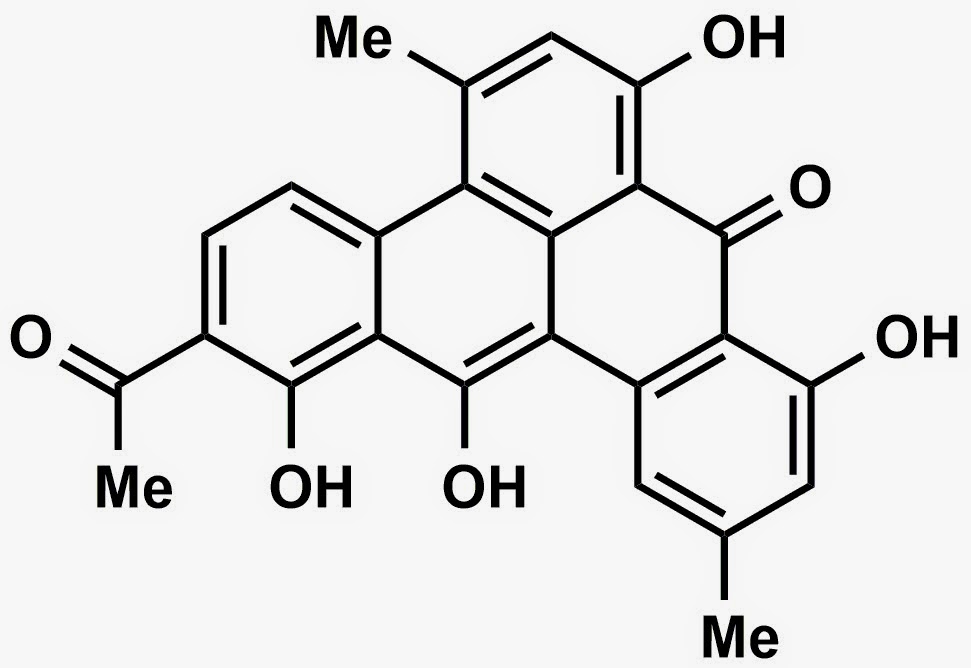
This Angewandte Chemie article by Prof. Christian Hertweck (HKI, Germany) held many such surprises for me. While poking around in bacterial genomes, Hertweck and team discovered gene sequences for secondary metabolites, or what organic chemists usually call "natural products". When they cultured a certain Clostridium strain from their collection, a deep purple dye emerged.

Dubbed clostrubin (see right), the pigment possesses several striking features. First, its shape: this five-ring topology, dubbed a benzo[a]tetraphene, has never been documented from living organisms. Second, although polyketides commonly come from other microbes, this is the first the team had ever observed in an anaerobe. To compound the mystery further, the folding pattern itself - polyketides come from long chains of simple precursors - had never been seen.

Most exciting for all involved: the compound shows high activity in assays against MRSA and VRE, two highly resistant strains feared for their prevalence in hospital-based infections.

So, who wants to be the first to make it?

Sunday, October 14, 2012

Digging Nobel Data

The hot topic in the chemblogosphere this past week? The 2012 Nobel Prizes.

Just after the fervor had died down, Samuel Arbesman over at Wired wrote a piece about data mining the Nobel prize nominees. Well, there goes my weekend!

Sea Creature? Alien ship? Nope, just a light fixture.
See, the Nobel foundation (wisely) restricts release of the nominations until 50 years have passed. Thus, the data are somewhat dated, and they're not available online for all the prizes yet; sadly, Chemistry currently lacks any nomination data. But, ironically, a fully searchable database exists for Physiology and Medicine prize nominations, ca. 1900-1951.

Raw Hits - Playing around, I entered in terms one might choose for interdisciplinary awards: chem (235 hits), drug (only 7 hits!), crystal (54 hits), antibiotics (28 hits), and reaction (84 hits).

Usual Suspects - Future winners no doubt collect their share of early nominations, such as Waksman (streptomycin, 43 nods), Fleming (penicillin, 34 nods), and Ehrlich (chemotherapy / staining, 73 nods).

Superlatives - Obviously, the "career prize" aspect of the Nobel entered into judging quite early. Paul van Grutzen nominated Emil Abderhalden in 1917, saying "With great elegance [he] has solved many problems in chemistry." Two nominators in 1901 and 1905 nominated Albert von Koelliker for "A 60 year career in anatomy." In 1950, 10 nominators chose to "stuff" the ballot box in favor of Edward Kendall "...for his notable contributions to biochemistry."

Special Award Goes to...Prof. Jacques Loeb (UChicago / UC-Berkeley / Rockefeller). Far as I can tell, Dr. Loeb wins for most nominations in this category - 79 times, from 1901-1924 - without winning the Prize. His work involved artificial parthenogenesis, inducing egg cells to begin division without prior fertilization, using chemical signalling molecules and UV light.

Readers: Have fun with the database, and let me know what you find in the comments!