Showing posts with label pseudoscience. Show all posts

Saturday, December 1, 2012

WWWTP? 'Heroes' Edition

For more WWWTP, see earlier posts here and here, and ChemBark's here and here.

Recently, my special someone and I decided to watch NBC's Heroes, front to back (thanks, Netflix!) Not familiar with the show? Its premise: special powers imbued by random genetic mutations, sort of an X-Men-meets-Matrix hybrid serialized prime-time drama.

So, you might expect that since several major characters study molecular biology, and the show groks concepts like viral mutation, limb regeneration, and space-time fluctuations, that it would hire a scientific consultant to help with set design...right?

...Wrong. Below, I've snapped some stills from Seasons 1 & 2 of the show. No plot spoilers, just pure, unadulterated fake science-y goodness.

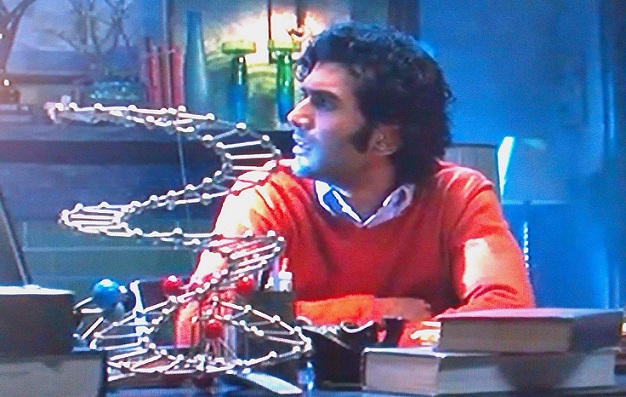
Genetics professor Mohinder Suresh muses in his Brooklyn, NY apartment.
Methinks that "ladder" thing is supposed to represent DNA.
No telling what the giant 1960s molecular models behind it are...

A chalkboard still from Season 2, in Dr. Suresh's "lab." The figure label (offscreen) reads: B-DNA.
There's so many things to comment on here (syn? A3? double-bonded H?).
Most remarkably, it's pretty close to the base pairs its supposed to represent! (B for effort?)

Across the lab from the "B-DNA" chalkboard, there's some free-standing whiteboard doodles.
The resolution isn't high enough (pre-HD) to figure out exactly what these were,
but I think the bottom structures might be riboses. Hey, he's a geneticist, right? : )

Also in Season 2, main character Peter visits the home of a former molecular biologist. Of course, she, like most scientists, has framed journal covers and science art adorning every wall of her home (don't we all?).
Guess we'll just leave this one to 'artistic interpretation.'

Update (12/1/12) - Chemjobber has SPOILED it, telling me about maitotoxin's appearance in the later episodes. I've found a 2008 post that seems to agree...

Thursday, September 27, 2012

Methylamine Pseudoscience

Please see updates, posted below original piece. Thanks!

Pseudoscience strikes again. About a month ago, over at Slate's Brow Beat culture blog, Mr. Daniel Lametti - he of 'Ph.D.-Waste-Of-Time' fame - wrote a piece analyzing a recurring Breaking Bad plot device: the theft of large quantities of methylamine for the characters' illegal methamphetamine operation. The meat of the post:
"As a post on Reddit asks, since Walt is a brilliant chemist, couldn’t he just synthesize the stuff himself?
Yes, and pretty easily. There are many different ways to make the compound; with little more than an introductory organic chemistry class, you could probably synthesize it in your kitchen sink. (Brow Beat doesn’t recommend trying to make methylamine in your kitchen sink). Chemically speaking, methylamine is just ammonia with one hydrogen atom swapped out for a methyl group—a carbon atom and three hydrogen atoms. Without getting into too much detail, an easy way to achieve this swap* is to “bubble” ammonia (a gas) through methanol (a liquid) that’s been laced with a dehydrating agent like Silica gel. You could probably buy these chemicals at Home Depot and CVS. Silica gel packets are often packaged with new shoes and electronics to keep them dry."
Wait, huh? Let's start from No.

As a practicing synthetic organic chemist, I agree with the statement that silica gel dehydrates solvents by water absorption. Sure. But I've heated plenty of alcohols in the presence of silica gel, and 99% of them don't spontaneously lose water! (That would be a rocking olefin synthesis, if it worked...)

Methylamine: Easy as hooking up five pressurized reactors in your kitchen sink.
Credit: Albermarle
Let's put this on firm scientific ground. The reaction in question, a nucleophilic substitution, could theoretically occur by two mechanisms: SN1, where the -OH group of methanol dislodges to form a methyl cation (?!?!), followed by subsequent ammonia bonding; or SN2, where the ammonia directly displaces the -OH, one step, no intermediates.

In this scenario, both are extremely unlikely, especially at room temperature and pressure.

Now let's talk practicality: which company will sell you a cylinder of ammonia gas for 'home use?' (Not Home Depot). How will you get your methanol? What's the plan to isolate the (volatile, stinky) methylamine from the complex mixture of compounds this theoretical reaction produces?

Well, how do companies make methylamine? Albemarle technical documents to the rescue! Seems that mixing methanol and excess ammonia at 300-500 degrees Celsius, under pressure, over a zeolite catalyst will produce an equilibrium mixture of methylamine, dimethylamine, and trimethylamine (favored). After fractional distillation, the trimethylamine can be streamed over an amorphous silica / alumina catalyst to disproportionate it back into methylamine.

Not a kitchen sink in sight.

Update, 8/17/13 - This piece jumped back into the spotlight as Breaking Bad winds down its 5-season run. Thanks to Dylan at WaPo's Wonkblog for linking back here.

Commenters have taken issue with my description of the reaction, so I've slightly changed the text for clarity (methods / mechanisms, "forms" cations, oxidation...)

8/19/13 - Arguments have cropped up, in multiple forums, about reagent availability, feasibility of the chemistry at small-scale, mechanism, purification, etc. I blame myself for not refining my argument well enough in the original post. Very directly, I'll re-state the major arguments:

1) The silica gel + methanol + ammonia route will not produce methylamine as stated
2) Although an experienced chemist *could* produce methylamine using different reactions in a kitchen sink, he will by no means produce enough to support a burgeoning criminal enterprise which manufactures methamphetamine at multi-kilo scale.

*Curious - Appended at the bottom of the essay is a thanks for Prof. Adam Braunschweig, faculty at NYU now UMiami.. To what extent did Prof. Braunschweig proofread this post? Did he sign off on the "kitchen sink silica gel" concept in the middle? I can't possibly imagine that he thoroughly vetted this essay.
Sunday, March 18, 2012

Too Good to be True - The "98% Turnover" Dilemma

"If it sounds too good to be true, it probably is" - Anonymous Skeptic


On a gorgeous Spring day, I awoke to find birds singing and the sun shining. After rolling up a window shade and brewing a fresh pot of coffee, I was ready to tackle overnight emails and visit the great Twitter machine.


The first thing I saw?


("Your atoms?" Do I own my atoms? Does anyone? And doesn't that figure seem, well, a little high?)


OK, wait, I'm a scientist, so it's just in my nature to be skeptical. But with 50+ re-tweets, and 18 'favorites' already, I felt this 'fact' needed a bit of perspective. Surely a little digging (assisted by @doctorchemed and @Chemjobber, thanks!) will turn up the truth, right? 


First, let's stop at the likely source for the factoid: this segment from a 2007 All Things Considered episode. It mentions the mysterious "98%" figure, and goes on to give a perfectly rational-sounding explanation, backed up by a scientist (Ph.D. = credibility). The reporters' comments tend towards the usual suspects - oxidative stress, dead skin cells, DNA copying errors. It's well known that several body tissues do indeed cycle through, so they leave another breadcrumb trail for us to follow: "...a study published in the Annual Report for Smithsonian Institution (huh?) in 1953..."


"Mr. Isotope" Seal of Approval?
Source: Fourmilab
Well, thanks to archive.org, we can find the "study" fairly quickly. It seems that, in 1953, Paul C. Aebersold (dubbed "Mr. Isotope" by the U.S. Atomic Energy Commission), wrote to the Annual Report of the Board of Regents of the Smithsonian Institution. Given the appearance of annual budgets, secretarial minutes, and auction items, this has to be the AEC's equivalent of a progress report. Consider Aebersold's title: Director, Isotopes Division, Atomic Energy Commission (now part of the NRC). While it's tempting to believe this is a "scientific publication," there's little in the way of hard data, and the text reads more like an historical recap, or perhaps a biography, than an experimental procedure. Read the following quotes, from p.239 of the document:
"We need more people trained in the use of isotopes — people who can apply this new tool to tomorrow's problems in medicine, science, and technology - more 'isotopologists'...We have hardly scratched the possibilities of scientific achievement."

Make sense yet? It's a funding appeal! The speech recounts the glory of the atomic age, from the Curies to the end of WWII, and the line about the "approximately 98 percent of the atoms in us..." (p. 232) serves as another brick in the staircase, built towards the temple of program renewal.


Since Aebersold discloses no study or reference data, my skepticism mounts. If we really recycle almost our whole body, how could we detect blood contaminants, such as PFOA or BPA? How could teeth be stained, if you were always churning out new enamel? (you're not) How would "belly-button microflora" from different places still be detectable on you, if you were always throwing them away?


George de Hevesy
Source: Nobel Foundation
Let's go one more notch back in the literature. George de Hevesy, 1943 Nobelist in Chemistry, developed many of the earliest radiotracers, radioactive compounds used to monitor human, plant, and animal metabolism. Read his Nobel lecture; de Hevesy indicates, with hard data, that work on rabbit skeletal exchange (that is, watching radioactive phosphorus diffuse in and out) resulted in 6.7-29.7% change in various bones over 50 days. So, for certain tissues (the higher values), we could say that, over the course of a year, the 98% value sounds correct. But for the 6.7%? Well, a year is not 746 days long, so that can't possibly apply. Further de Hevesy work utilized labeled calcium ions to show that only 1/3 of the mouse skeleton is replaced during its entire life.


Source: Edupics
Well, old data is exactly that...old. So, you have to flash forward in time to verify conclusions. Here's an NC State Extension primer on osteoporosis, which mentions that approximately 1/5 (20%) of the adult human skeleton is renewed each year. 


So, why all this focus on bones, bones, bones? Turns out, the skeleton in an average human being weighs somewhere around 12-18% of total weight. If 20% is renewed, that means 80% is not. Thus, without considering any other vital body system (neurons? scar tissue? cartilage?) the 98% exchange can't be correct - somewhere around 10% of your body's atoms stay unchanged every year!


(Readers, if you see factual or logical errors here, I welcome future impassioned discussions in the comments!)