Showing posts with label cross-coupling. Show all posts

Monday, March 16, 2015

Acylboronates Enter the Mix?

Just a few days removed from the great Synthesis Machine debate of '15, a new paper has appeared that prompts me to wonder: might other protected boronates work in this chemistry?

The Bode group, now at ETH-Zurich, discloses in JACS ASAPs some intriguing bifunctional acylboronates. Much like their MIDA boronate cousins, these, too, are stabilized by an N,O-chelating ligand, demonstrate a shelf-life of several months, and are easily prepared in one step from their potassium trifluoroborate salts.

Do you suppose these reagents could survive the strongly basic aqueous conditions used for MIDA deprotection and subsequent cross-coupling? The authors, comparing MIDA-acylboronates against NOF-acylboronates under aqueous hydrolysis conditions, claim:
"In all cases, the bidentate, monofluoroacylboronates were much more stable than the MIDA variants and should be sufficiently stable* for most applications." 
If this holds true, one could imagine capping Burke's automated syntheses with carboxylic acid derivatives without resorting to bulky t-Bu esters or exotic silyl-protected esters.

*Now I'm just brainstorming, but could catalytic conditions be found to transmetalate the acylboronate to, say, Rh or Pt? 

Tuesday, August 6, 2013

CPME? New to Me!

While reading through the latest Org. Lett. ASAPs, I came across a slick cross-coupling reported by the Walsh group (UPenn). The reaction unites acetamides and aryl chlorides, helped along by a "hybrid" Buchwald-Kwong pre-catalyst. Neat stuff.

Source: Org. Lett. | Walsh group

A certain passage caught my eye, midway down the second page (emphasis mine):
 "...four common solvents [toluene, cyclopentyl methyl ether (CPME), dioxane, and dimethoxyethane (DME)] were screened..."
All 'common' solvents, even CPME? I don't recall seeing that solvent in Trevor Laird's OPRD piece. Or on several solvent boiling point charts. In fact, I don't think I've ever used it...and I'm doing cross-couplings all day!

A quick literature dig on CPME turned up this OPRD, perhaps its grand introduction to the process scene. Looks like it exhibits several advantages over diethyl ether (higher boiling, lower peroxide formation), and improved safety metrics over dioxane or THF.

Readers: Am I just late to the game? Are process folks everywhere charging liters of CPME into reactors 24/7? Please clue me in.

Thursday, June 13, 2013

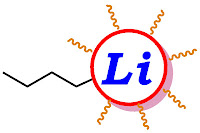
BuLi: Not Just a Base Anymore

When do you reach for that bottle of n-butyllithium at the back of the fridge? Making anions, sure, but BuLi's also great at ripping off halogens, destroying esters, alkylating imines, or swapping lithium for other metals (see: Sn, Zn, B, Cu, etc...).

What about using BuLi as an off-the-shelf cross-coupling partner? Sure, sounds like a methyl-ethyl-butyl-futile joke gone too far, but there're quite a few of those aryllithiums in catalogs nowadays...

Looks like Ben Feringa's got you covered. In Nature Chemistry, his group reveals that slow addition of a diluted organolithium to an aryl or vinyl bromide mixed with some electron-rich Pd(0) precatalysts provides alkylated products with high selectivity. At room temp. In one hour. In the presence of chlorides, esters, free alcohols, and all sorts of things that usually gum up the works. Zoinks!

I'll admit it - As someone who's spent a decent part of my life trying to glom one carbon onto another (grumbling while I purified yet another organotin or boronate), these initial results look promising. I'm sure they're furiously working on the alkyl-alkyl (sp3) coupling as we speak - good luck, that one's gonna be a lot harder.

P.S. Kudos for a well-thought-out Supporting Info section, too. The authors discuss their optimization process almost "stream-of-consciousness"-like, letting you vicariously learn the chemistry along with them.