Showing posts with label chemophobia. Show all posts

Tuesday, January 27, 2015

Another Year, More Chemophobia

Over the holiday break, a few people sent me pictures and links to demonstrate that we still have plenty to do to counter chemophobia in 2015. Here's a sampling:

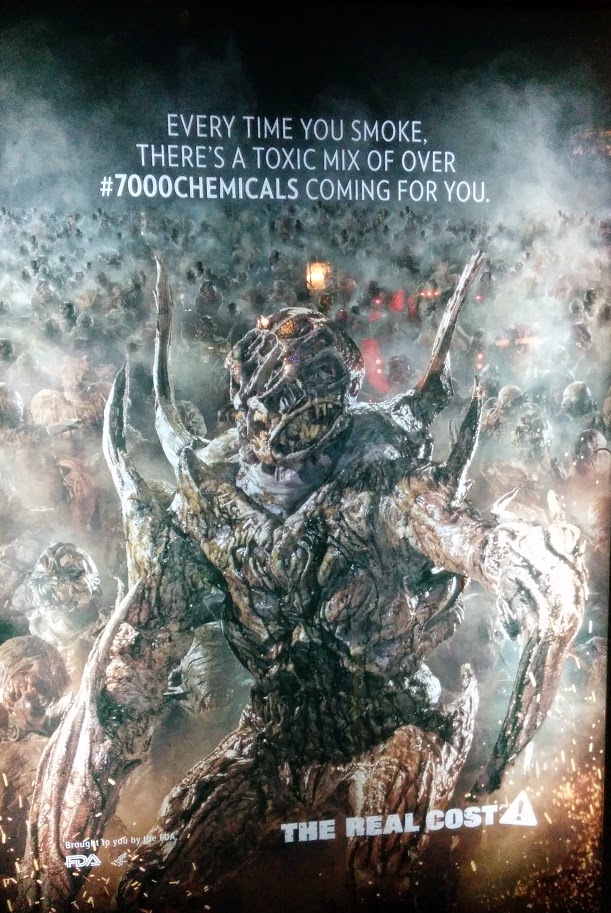
1. U.S. FDA Cancer ad. Have you seen these pictures around airports, bus stations, and subways? This one - which I'm sure is equally supposed to simultaneously discourage youth smoking (while reminding them of Sauron from Lord of the Rings) appeared in my inbox a few days ago:

Nothing like some straight-up chemophobia from Big Government.

2. Health beans - now chemical-free!


Thank Goodness that 'omega fatty acids' or 'vital antioxidants' aren't chemicals!*

3. Microwaving'll kill ya. As a throwaway line in the Newsweek article interviewing famous futurists about whether or not Back to the Future Part II accurately predicted the future, Syd Mead, a "visual futurist" who designs sets for sci-fi movies, said this:
"No, I don’t remember [how the film depicted food]. I hope it wasn’t pills. [laughs] That was a fixture in future films. Popping steak or spinach or whatever in a pill. I hope it never comes to that."
"Microwave dinners are bad enough. Of course, microwave upsets the molecular structure of food, which isn’t too terribly healthy."
I've heard these arguments before, but neither one makes any sense. Healthy people routinely take all sorts of food supplements in "pill form" - vitamins, curcumin, antioxidants, essential oils - the list goes on and on. And as far as I'm aware, microwaves can't actually "upset" (change) the molecular structure of food.

Reminder: Syd consults for science fiction movies. We have a lot of work to do.
--
*Yes they are.

Friday, June 27, 2014

Monday, March 24, 2014

Huh?

While catching up on my old issues of C&EN, I happened across this ad on p. 24 of the March 10 issue:


At the risk of sounding insensitive, can someone please tell me what "the Elements Science" means?!? 

Perhaps some editorial help next time? Tamao's world-famous named reaction and many contributions to synthetic chemistry deserve better. I especially love his anti-chemophobia stance on this profile page at Kyoto U:
"It saddens Prof. Tamao that in recent years people have begun to associate negative images such as environmental pollution with the word ..."chemicals" ...He wishes the benefits of chemistry were more widely known. He points out that organic silicon compounds, his field of specialization, are chemicals that play a very familiar role in our lives. We are in contact with them every day without realizing it, in forms ranging from cosmetics to electronics. "When a new organic compound is created the most amazing things become possible, one after another," says Prof. Tamao. As he laughs impishly, it seems as if a flame of creative energy more powerful than the magic spell of the most brilliant wizard is quietly burning behind his eyeglasses."

Sunday, August 18, 2013

Link Farm: Chemistry Communication

Blogs, like any medium, shift, change, and grow over time. At first, I devoted my humble corner of the internet to food chemistry. After a while, it became a tool to root out misconceptions about chemistry in popular culture.

Well, to borrow a phrase from Click and Clack, I've come around for the "third half of the show" - figuring out how to bridge the gap between the growing public desire for accessible, informative, entertaining science content and chemistry's approach to that communication. A lot of terms have swirled around this issue: "punching down," #BogusChem, "Inside Baseball," 'in-reach' not outreach, #chemophobia, and "dumbing down," to name just a few.

Thanks for the tip about the magnets, Andre!
(P.S. Yes, I know "D" isn't an element)
This post will serve as a (growing) collection of pieces dedicated to thoughtful chemistry outreach.
Readers: Have a favorite post I haven't included? Send it along in the comments.

Janet Stemwedel, Doing Good Science: "When we target chemophobia, are we punching down?"

Chad Jones, The Collapsed Wavefunction: "Punching down? I don't remember swinging at all."

Ash Jogalekar, The Curious Wavefunction: "Where's the chemistry lobby? On why we need a National Center for Chemical Education."

See Arr Oh, Just Like Cooking: "The Chemistry Popularity Conundrum"

Michelle Francl, Slate: "Don't Take Medical Advice from the NY Times Magazine"; Nature Chemistry: "How to counteract chemophobia";

Paul Bracher, ChemBark: "Combatting Chemophobia"

Rebecca Guenard, Atomic-O-Licious: "Chemistry Isn't Just About Chemicals"

Science 2.0: "Chemophobia - The Unnatural Fixation of Activists"

Chemjobber, Dr. Rubidium, See Arr Oh, Chemjobber: "Chemistry Avengers" (podcast)

Marc Leger, Atoms and Numbers: "Consider the audience when addressing chemophobia"

Chris Clarke, Pharyngula: "Did you know douchebags are full of dihydrogen monoxide?"

Andrew Bissette, Behind NMR Lines: "In defense of #chemophobia"

More to come...

Thursday, August 15, 2013

Hey WIRED, Why No Chemistry Love?

101 Signals, WIRED Magazine's latest compilation of "...best reporters, writers, and thinkers on the Internet" just went live. They've broken down the list, which includes blogs, Twitter, and Tumblr feeds, into chunks: Business, Design, Consumer Tech, Gov't & Security, Culture, and Science.

Here's the Science group. A distinguished bunch, but guess what?
Not a chemist among them!!!

Sure, we've got great, well-known personalities like Ed Yong (Not Exactly Rocket Science) and Randall Munroe (xkcd), Phil Plait and Robert Krulwich. I see plenty of physicists, biologists, astronomers, geneticists, and science writers, but no chemists.
And yet, two Tumblr accounts with the word "f*ck" sprinkled in (Classy, WIRED, classy).

I suppose Maggie Koerth-Baker, who has written about chemistry several times, is the closest we get to full representation. But she's plugged as the BoingBoing science editor / NYT columnist, with nary a mention of chemistry to be found.

So, what gives? Folks on Twitter have suggested a few issues with the chemblogosphere, from "in-reach" in place of outreach, to a tendency to "punch-down," or even (gasp!) that our stuff just doesn't appeal to a mainstream audience.

All valid points. Well, allow me to retort: An aspect of chicken-and-the-egg surely works behind these listicles. Although we haven't fully ironed out all of chemistry bloggers' quirks yet, not featuring our blogs in mainstream offerings just exacerbates the problem!

How can we be part of the solution,* if we can't even get in the door?

In case a WIRED staffer happens upon this post, please consider the following widely-followed, high-quality chemistry blogs to include in your next collection:

In the Pipeline
ChemBark
Elemental
The Curious Wavefunction

*Please don't say, "If you're not part of the solution, you're part of the precipitate." We've all heard that one.

Sunday, August 11, 2013

JFK Scare: Analytical Chemistry at the Airport

Please see below for updates as I receive further information...

As reported by multiple news outlets (CNN, Daily Mail, The Atlantic), a 'suspicious package' leaked an unknown substance* onto two customs inspectors at JFK International Airport Sunday afternoon. When the workers fell ill, the FBI quarantined two facilities - one customs, one mail sorting - and tested the material.

Initial assays indicated potential organophosphate chemical weapons. Later tests, however, confirmed that the substance was actually phosphoric acid, leaking from a faulty cosmetics package. The two inspectors, after receiving on-scene treatment, declined further medical attention.

A few points about this story (emphasis mine):
  • Most news agencies reported hesitantly, but not the Daily Mail, which declared: "The package from China tentatively tested positive for VX nerve gas, which can be used as a weapon of mass destruction..." (They even included a strangely-rotated space-filling model of VX in the article!)
I'd be quite interested to know how the FBI field tests for organophosphate nerve agents (Sorry, Daily Mail, but VX, due to its high boiling point and viscosity, is actually not a gas but a thick liquid much like phosphoric acid). I'm aware of certain colorimetric pesticide test strips, and certainly blood chemistry assays for exposed individuals would tell the tale.

But could phosphoric acid give a false positive here? Its chemical properties aren't overall very similar to nerve agent. Unlike VX, phosphoric acid has acidic protons, rendering a much different reactivity and solubility profile. VX soaks deep into skin due to its carbon appendages - hence, organophosphate - which wouldn't really occur with the acid. Perhaps JFK sent a sample out for 31P NMR? This analytical technique would show a resonance close to that of VX, which might incite a high-threat response. Perhaps an LC-MS might also ring warning bells: both compounds should show a fragment around 94 m/z.
  • The Atlantic cheerfully summarized: "It turns out what made the two men sick was actually organophosphate, an ingredient in soda pop."
If I ever find organophosphate in my Coke can, I'm suing. That is, if I survive the encounter...

Organophosphates, to which VX, sarin, soman, and several potent insecticides belong, have alkylated (carbon-functionalized) bonds on their oxygen atoms. Once ingested or absorbed, they tend to interfere with acetylcholinesterase, an enzyme involved in neural signaling. The reporter perhaps meant to say "phosphorus compound" or even "acid," but unfortunately chose the wrong word.

One more thing: I completely understand the highly cautious nature of the law enforcement response. Organophosphates can sicken or kill at remarkably low doses, thus their unfortunate appeal as terror weapons. If any of my readers have experience with airport chemical detection, please write in to set me straight on your detection methods of choice.

Update, 8/12/13 - Changed "parent peak" to "fragment"

*Update 2, 8/12/13 - Chemjobber points out, via Twitter, that the NY Post reported ordinary nail polish remover (usually acetone, or ethyl acetate / iPA) as the culprit. Now I'm even more confused as to how this triggered a nerve agent analytical read!

Update 3, 8/12/13 - Commenters on Reddit and JLC (thanks!) remark that airports have at their disposal DART-based benchtop MS, or perhaps Barringer IONTRAP ion mobility spectrometers. Another commenter suggests M8-M9 detection paper. Vibrational spectroscopy (Raman, IR, etc) has been bandied about as well.

Tuesday, July 30, 2013

WWWTP? Palmolive Edition

I happened upon this bottle in the store yesterday, and found the marketing statement quite curious:


Now wait just a minute...what does that even mean? Does a human contain "no unnecessary cells," or a delicious meal "no unnecessary ingredients?" Perhaps this is the Strunkian ideal* of chemophobic marketing:
"A sentence should contain no unnecessary words, a paragraph no unnecessary sentences, for the same reason that a drawing should have no unnecessary lines and a machine no unnecessary parts."   - Strunk and White, The Elements of Style
So, what 'necessary' chemicals does Palmolive Free & Clear contain?
Source: Colgate-Palmolive 
So we have foaming agents, detergents, thickeners, stabilizers, fragrances, dyes, and water - a.k.a. every ingredient present in most dish soaps! 

This feels like Kraft Mac & Cheese redux. Please understand that I'm not against informed consumer choice, and I certainly support labeling transparency** and product safety. But this marketing slogan is at best meaningless, and at worst drags popular punching bag "chemicals" through the mud. Again.

At least it can wash off with Palmolive Pure + Clear - Contains Necessary Chemicals.

*Except, of course, that the authors of this dish soap piece seem to have omitted a verb.
**Next up: Chemplex (TM) brand butyllithium: Contains 95% random C-Li bonds (and fragrance!)

Wednesday, July 10, 2013

(More) CNN Chemophobia: What's a Chemical, Again?

(For more posts in this series, please click here and here...)

*PLEASE NOTE: The text of the original CNN article has changed!*

--------

Hey there, Cable News Network. We really have to stop meeting like this.

The latest snafu comes from CNN's Chart health blog courtesy of Twitter contact (and fellow blogger) Marc. The piece recaps an Opinion column written by Purdue neuroscientist Susan Swithers, which explores a strange and interesting phenomenon of artificial sweeteners: apparently, overconsumption of these compounds can fool the body into reacting as if sugar (glucose) were present, leading to unforeseen metabolic conditions.

The quibble comes a few paragraphs down, where the train falls off the track (emphasis mine):
"There are five FDA-approved artificial sweeteners: acesulfame potassium (Sunett, Sweet One), aspartame (Equal, NutraSweet), neotame, saccharin (SugarTwin, Sweet'N Low), and sucralose (Splenda).  
All of them are chemicals. “Saccharin was one of the first commercially-available artificially sweeteners, and it’s actually a derivative of tar,” says Swithers. 
Natural sweeteners, like Stevia - which has no calories and is 250 times sweeter than regular sugar - is not a chemical, but is still a processed extract of a natural plant, and increases your health risks similar to artificial sweeteners."
Wait, what did I just read? From a neuroscientist, no less! (perhaps a misquote?)

One of these comes from a plant.
But all of these things are chemicals
1. Stevia, a commercial FDA-approved non-nutritive sweetener, is most certainly a 'chemical.' I've included a handy graphic (right) in case anyone was confused.

2. That first statement in the second paragraph? Quite true; all five compounds listed certainly are chemicals, too! Kudos for that one.

3. Can I tell you how tired I am of fighting against the "everything from tar = bad!" mentality pervading modern-day society? Anyone dusting off that tired chestnut needs to rub their eyes (hard) and look around. They probably recorded the line using a polymer-based recorder (made from tar). On interview day, both folks probably wore synthetic fibers (made from tar) and sat on plastic chairs (made from tar). They may have quaffed their thirst from water bottles (made from tar) or eaten a Twinkie (made from tar). Perhaps they drove to work that day, using gas (made from tar) in their car (made from tar...well, and rocks), down a highway (made from tar) singing to a CD (made from tar) and passing farm stands selling fruits and vegetables (made from dirt, gases, and chemicals).

Until next time, CNN. And there will, of course, be a next time.

Update, 7/10/13: Fixed small error in steviol structure.
Update, 7/11/13: A commenter points out that stevia sweetness relies on glycosides; I'd originally drawn the aglycone above. Fixed, Thanks!

Tuesday, April 2, 2013

Lake Erie Chemophobia: A Tale of Two Anatoxins

At first, I thought it might be an April Fools' prank in poor taste, but then I read the latest PNAS -

Looks like Lake Erie wants to hurt you.

OK, not the lake itself, but the potentially toxic concentrations of cyanobacteria formed in recent record algal blooms. Yesterday, a multi-institution group of ecologists and environmental engineers reported a 'perfect storm' of runoff fertilizer, warm weather, and quiet waters in the lake that led to a marked increase in 2011 cyanobacteria populations. In fact, there appear to have been two blooms - the first Microcystia, and the second Anabena, two bacterial baddies* associated with liver and neurotoxicity. Scary stuff!

Well, the press coverage stemming from the study hasn't calmed fears. Here's a sampling from NSF, Huffington Post, and Discover. The HuffPo title really runs the chemophobia angle:
"Lake Erie Blooms Expected to Continue, Threatening Ecosystem, People." (!!!)
They dress the presser up for the occasion, with words like noxious, toxic, ugly, hazard, and problem. Discover writes 'toxic' three times, without pointing out what the toxins are! Even the normally staid NSF jumps on the bandwagon, referring to a mysterious 'liver toxin.'

What types of toxins are we talking about? Actually, that's a bone of contention here: the researchers only mention two, microcystin and anatoxin. Those turn out to be confusing terms, since the generic names cover >80 types of different microcystins, and at least two anatoxins [A(s) and A, right]. One assumes that the scariest anatoxin (Anatoxin-A, or 'Very Fast Death Factor'), operates here, which certainly warrants concern.

But, sans information, there's a panicked sense to the releases not grounded in the published text. Both Discover and HuffPo indicate "~200x concentration" of "toxic stuff" in the cyanobacteria-enriched water. Do the researchers actually say this? Let's go to the PNAS (emphasis mine):
"Surface toxin concentrations could have reached over 4,500 μg/L in early August assuming all Microcystis and microcystin formed a surface scum 10 cm in thickness. The World Health Organization guideline for microcystin in recreational waters is 20 μg/L..."
This statement relies on multiple qualifiers and conditionals. Where's your skepticism, science writers? Yes, things were bad in Lake Erie in 2011, but to spit this couched statement back as fact does a real disservice.

Worst part? Of the three media, only Discover actually links back to the actual study. Sigh.

*Boy, I love science: the Purdue blue-green algae fact sheet I linked to for Anabena indicates that ecologists nickname the major detected species (Anabena, Aphanizomenon, Microcystia) Annie, Fannie, and Mike!

Friday, March 15, 2013

Please Set Me Straight on Synthetic Yellow Dyes

Dear Ms. Hari and Ms. Leake,

Good evening. Earlier tonight, I read your change.org petition calling for a ban on Yellow #5 (tartrazine) and Yellow #6 (Sunset Yellow) in Kraft Mac & Cheese. I must say that, while not a mac connoisseur myself, I have certainly eaten it once or twice. Furthermore, I agree that all processed food companies should periodically review their popular brands, taking into consideration consumer sentiment, and should make every effort to produce quality goods. 

Since your petition now has well over 230,000 signatories, I assume many in the general public agree with us. But I must know: Where did you source the scientific data for your claims?

Let's start from the top:


"Artificial food dyes...are man-made in a lab with chemicals derived from petroleum (a crude oil product, which also happens to be used in gasoline, diesel fuel, asphalt, and tar)."
Well, I can't disagree with the first part - they're certainly synthetic azo dyes. However, I'd like to discuss your second point, where you equate 'petroleum-derived' to well-known flammable, smelly, or oozy black 'chemicals.' These azo dyes don't really resemble the compounds you've mentioned at all - gasoline and diesel are long saturated chains of carbon atoms, while tar / asphalt are collections of polycyclic aromatic hydrocarbons (PAHs), which might resemble these dyes if you took just the naphthalene portion (right-hand side), deleted the "OH" group, and chained a whole bunch of 'em together.
Yes, azo dyes come from organic chemists (like me!) in a lab somewhere. But, you know what else comes from petroleum? Pharmaceuticals. Plastics. Cosmetics. Synthetic fibers. Coatings. Many of the modern materials you interact with on a daily basis.
"Require a warning label in other countries outside the US."
I believe the US also mandates (Code of Federal Regulations Title 21, section 74.1705) inclusion of tartrazine on labels - I've seen it listed on my mouthwash. (Incidentally, that same CFR page sets exacting limits on impurity content in these dyes)
"Have been banned in countries like Norway and Austria (and are being phased out in the UK)."
Are we just lifting directly from Wikipedia by this point? 
"Yellow 5 and Yellow 6 are contaminated with known carcinogens (a.k.a. an agent directly involved in causing cancer)."
Now here's where things get interesting. Head on over to TOXNET, the National Library of Medicine toxicology database. I've looked up both Yellow 5 (tartrazine) and Yellow 6 (Sunset Yellow), and I can't find any positive studies suggesting carcinogenicity. Ditto both Wikipedia pages, and even my copy of the Merck Index (13th Ed., pp. 9091 and 9157).
What about the potential impurities, you ask? Sunset Yellow can indeed be contaminated with Sudan I (see picture, above), a non-sulfonated version of the compound. Sudan I lists as a Class 3 Carcinogen, which (thanks, ACS!) means "unclassifiable as to carcinogenicity in humans." The European Food Safety Authority (EFSA) actually re-evaluated Yellow 6 in 2009, declaring an acceptable daily intake and noting Sudan I contamination was well below the allowed limit for lead in processed foods.
I won't argue against your claims regarding hyperactivity and allergic reactions; the Hazardous Substances Databank (linked through TOXNET) indicates several studies in which patients do indeed respond poorly to artificial dyes. However, I will note that the responsive patient percentages are often low, and many weren't deemed statistically significant relevant to placebo.
I don't disagree with consumers' rights to petition companies for product changes. But please, check the science, lest you lapse into harmful chemophobia.
Thanks,
See Arr Oh

Update (8:00AM 3/15) - @thefoodbabe contacted me on Twitter with the following: "you are incorrect in your critique of our petition, I've got to go interview live with CNN now - Ciao"

Update 2 (9:00PM 3/15) - CNN posted two responses to the petition.
One leans scientific, the other mostly re-states the bloggers' objectives.

Monday, March 4, 2013

(Monday) Fun: Axe Cop Chemophobia?

c. Ethan Nicolle
Somehow, in all the rush to get Blog Syn #003A out the door, I totally missed my chance to post 'Friday Fun' on 3/1!

I may have mentioned (once or twice) my love for Internet comics. Specifically, I tend towards science-y ones, like xkcd or Ph.D. Comics, but for a complete change of pace I turn to Axe Cop.

Not familiar? It's an over-the-top parody about a super-powered policeman, who travels to other planets and meets lots of...um, unique crime fighters. Even better? It's coauthored by a 32-year-old cartoonist Ethan Nicolle and his 8-year-old brother, Malachai.

c. Ethan Nicolle

Now, Axe Cop always runs ridiculous, but one panel from the latest story arc (Axe Cop Gets Married) made me wonder. In the scene, a group of 'scientists' at an 'Atomic Science Lab' (again, written by a kid) are mixing chemicals when something goes horribly awry. The lab explodes, and the survivors mutate into animal-human hybrids.

Ridiculous? Unlikely? Sure. Funny? Of course!

But also a little bit sad - how young do we start to infer that chemical means something bad for you?
(Apparently around 8, I guess)

Happy Friday Monday!
SAO

Wednesday, January 30, 2013

Nitration Surprise

(File under "Learn something new every day")

Boom goes the peptide!

For some light bedtime reading, I chose Life Technologies' Molecular Probes handbook, a 1,000-page opus of how to make anything and everything biological light up in brilliant hues of Texas Red or Cascade Blue. Flipping to Chapter 1, I quickly glanced at the very first scheme in the entire catalog, and did a double-take: tyrosine nitration...by tetranitromethane!


TNM: First time's the charm!
Source: Molecular Probes Handbook
Not to tread on Derek - who has a good thing going with his "Things I Won't Work With" tales - but doesn't this look like it should be grandfathered in to his list?

"Rule of Six" violation? Check. Potentially explosive byproducts? Check Check. A brief glance at the MSDS shows some of the more exciting Hazard Codes ("H330 - Fatal if Inhaled"), and the Merck Index (#9305) ain't much better: TNM "attacks iron, copper, brass, and rubber" and "Has been proposed as [an] irritant war gas."

Fun!

But, lest I lapse into my own fit of hypocritical chemophobia, I should point out that this compound is apparently 'par for the course' for stalwart chemical biologists - it's been used since the 1920s to label proteins, and a 1966 JACS article dubs it "stable, specific, and gentle." Even PubMed brings up >600 references, so I suppose my initial gut-check was a bit unwarranted - TNM looks OK when used in dilute solutions. But, I'd still say you should think twice before considering it for routine bench work.

Saturday, January 26, 2013

Some Thoughts on BVO Writeups

Hello there, 'science beat' journalists! I hear that Gatorade* just announced it would eliminate brominated vegetable oil (BVO) from its ingredients list (guess that chemophobic change.org petition really worked, huh?)

Well, this is a chemistry blog, and I feel my skin crawl watching various scientific terms and concepts flying around sans context. So, let's set a few things right:

  • Bromide, bromine, and brominated all refer to elemental bromine, but they aren't interchangeable terms! Bromide refers to a single bromine atom with a full octet of electrons [reduced, or "Br(-)"], and is usually found in ionic salts (e.g. potassium or sodium bromide). Bromine refers to the element itself, a corrosive brown liquid. "Brominated" refers to a compound, usually carbon-based, that contains bromine atoms. Now you know.
  • Just because you cite the 2011 Scientific American article regarding BVO overexposure does not mean you've vetted the science! I've looked all over (WebMD, PubMed, SciFinder) for incidences of BVO poisoning, overdose, or excessive consumption, and I find...two. The 2003 NEJM (Ruby Red Squirt), and the 1997 J. Clin. Toxicol. (2-4 L of cola daily). Please don't say "a few" or "some" when you mean two.
  • Emulsifiers, such as BVO, don't "weigh down" or "sink" the citrus oil - they emulsify it! That means they help to disperse one liquid into another liquid, by promoting formation of tiny droplets of one inside the other. And it's not the use of "heavy" bromine atoms that does this, either. Even if it were, at 8 ppm (8 molecules BVO per ~1,000,000 of water), that's not a lot of mass! It's physics, folks. **Update (1/27/2013) -OK, you win this one, Internet! BVO really is a "weighting agent," and I won't harp on this point. Thanks, Prof. Kass. 
  • Chemophobia: Do we really have to have "chemical" in every lede? Much less reference the well-worn 'fire retardant' factoid? I'll tell you about another "fire-retardant chemical" widely found in soft drinks...it's called water.
Hope this helps!
-SAO

*A Pepsico brand, although some media relations person obviously told them to expunge all references to BVO or 'brominated' from their parent site...try the search box!

***Update (1/30/13) - CNN's coverage seems to have eschewed science to focus on PR reps and corporate statements: "...bromine is cited in some chemical company patents as a flame retardant." Sigh.

Thursday, January 10, 2013

Friday Fun: Breakfast Chemistry

Should we tell her we don't 
call it that anymore?!? 
Source: Hunie.com | Laura P.
Dr. LKB, beloved chemist of the Twittersphere, just passed along a chemophobic gem from Grist. Titled "Honest junk food advertisements show you what kind of crap you're really eating" - no [sic], that's really how it reads - the post points out recent work by a Silicon Valley-based graphic designer who's equated various GRAS food additives with a vast industrial chemical conspiracy. Here's a sample:

Each "honest ad" gets a bonus eye-opening disclaimer at the bottom, revealing, gadzooks! - snippets cribbed directly from respective Wikipedia pages.

Well, two can play this game! Let me tell you about my standard breakfast...
Every morning, I go downstairs to brew up a harsh brown slurry of stimulants, sterols, and terpenes (I usually take it with some aspartame / maltodextrin, thanks!). 
When my stomach grumbles, I reach for a 6-pack of whole wheat toroids, chock-full of gums, algin, sorbic acid, and sodium chloride. After 50 seconds of resistor-charring, I spread microbially-enhanced whey-milkfat composite all over it, ideally while it's still warm. 
Sometimes I'll wash this all down with a fiber-filled suspension of cellulose oligomers, ascorbic acid, and fructose. Yum!
[Sigh]. Chemists, how do you do mornings?

Saturday, January 5, 2013

WWWTP? "Unjunked" Candy

While shopping in Target (Tar-ZHAY) earlier tonight, some food in eye-popping purple & black wrappers caught my eye. UNREAL markets so-called "unjunked" candy, which contains "no corn syrup, GMOs, or artificial flavors." Naturally, I bought one ($0.89, not too shabby) and I can report that it tasted just like the intended Snickers bar facsimile.

But here's the rub: a list on the back (see picture) proudly displays corporate commitment to "chemical-free" - by transforming a bunch of scientific adjectives into pseudo-plural nouns. What, may I ask, is a single "hydrogenated?" Would you say "No Crafts" if your fridge were devoid of craft beer?

The 'organic' ingredients they've constructed the candy from include:
Milk chocolate (cane sugar, chocolate, cocoa butter, milk powder, organic blue agave inulin, skim milk, soy lecithin, vanilla extract), caramel (tapioca syrup, cane sugar, fructan (prebiotic fiber), organic palm kernel oil, whey, milk protein concentrate, organic cream, vanilla extract, salt, soy lecithin), peanuts, tapioca syrup, cane sugar, organic palm kernel oil, skim milk, peanut flour, salt, hydrolyzed milk protein, evaporated cane syrup, soy lecithin
Inulin? Fructan? New to me. Turns out both are fructose-based dietary fibers, which in this context replace some of the fats and sugars found in similar candy bars. However, these soluble fibers often aren't well-tolerated intestinally, similar to known gut troublemakers sorbitol, maltitol, or lactose. My current stomach ache indicates I might be susceptible; please think on my sacrifice when the Pulitzers go out next year...

P.S. I'm no marketing whiz, but "Unreal?" If unable = not able, and unclear = not clear, doesn't 'unreal' = not real? For a candy bar made without "artificial" ingredients? I think the intended sarcasm might be lost on the way to the checkout.

Wednesday, December 26, 2012

Holiday Chemophobia: Can't We All Just Get Along?

Know what this is?
Me neither.
Source: LWON
First: A belated 'Happy Holidays' to all those chemists already returned to work.

Second: From the Twitter-verse comes a post from the (normally) fine writers over at Last Word on Nothing

Titled "Secret Satans: Chem101" (get it?!), the post fits in with a holiday series at LWoN. I'll let the editors explain:
"We are choosing our most daunting subjects and writing about why they scare us."
As a reader, I expected to hear some gripes and groans about the unfairness of chem grading, those interminable labs, perhaps pronunciation of long IUPAC-mandated noms-du-chem. But instead, right in the introduction, I spot this: "cold sweats," "freaked out," "deep dread," "chemophobia."

Yes, readers, this is a science blog.

I can hear the commentary now: "Calm down, SAO, this is a snarky, fun, satirical holiday piece. Right?" Well, no. "Hate" and "hatred" both appear, as does "loathe," "disaster," "evil plot," and "screwed up." Cue up the sardonic comparisons, like "cryptic as Arabic" or "esoteric knowledge, secret formulas kept by early metallurgists and alchemists." One of the authors speaks of a safety mishap involving [sic] "bromide gas," which recounts how her inadvertent calculation error caused a building evacuation. Fun stuff!

And then there's the graphics. How many times must we plead - Don't let art directors draw your molecules! I don't know exactly what these "animal tracks in the snow" represent, but if the piece aims to vilify simple chemical knowledge, it certainly does that (P.S. I know they're from Shutterstock, but that doesn't excuse their inclusion).


So why am I so critical? Shouldn't we just give LWoN a pass, have a chuckle at a favorite scientific punching-bag, and move on? 

No. Blogs, and especially science blogs, should try to take the high road. We're the voice of reason, the nagging suspicion, the social conscience of the wild, woolly online world. We should aim to advise, not attack, and question where others condemn. That cute anecdote at the end? Doesn't make up for the 709 words you just used to drag chemistry through the muck.

You can do better.

Saturday, October 20, 2012

Goodness Gracious, Great Balls of...Sunscreen?

Actual AP headline yesterday: "Banana Boat recalls sunscreen due to fire risk." CNN, ever one for a scare, upped the ante with their headline: "Sunscreen could burst into flames on skin." (emphasis mine). Did I miss the part when sunscreen formulators started including white phosphorus in the mix?!?

Kidding aside, I'm not talking about "toxic chemicals" here; sunscreen already occupies a special place at Just Like Cooking due to the clouds of chemophobia swirling around it. The fire risk appears to involve two factors: engineering and consumer usage. An Energizer Holdings* corporate spokesman said the canister spray valve applies too much product, which leads to longer-than-average drying times. The exacerbating factor? Customers suffering burns engaged in barbecuing and welding immediately after application.

Well, what is so flammable about spray-on sunscreen, anyway? The ingredients list shows all the usual suspects: UV blockers, vitamins, surfactants, and polymers - none of which are particularly flammable. Two components catch my eye, though: isobutane and SD Alcohol 40. One commonly finds isobutane, the simplest branched hydrocarbon, in refrigeration coils and aerosol products. It could certainly ignite, but high volatility means that most of it flies away mere seconds after you spray it on. SD Alcohol 40**, however, is almost straight ethanol, and makes up a large portion of the overall spray. It would also fit the bill for physical properties: boils at 173 deg F, vapor pressure 40x lower than isobutane. A fog of ethanol slowly evaporating from your arms certainly invites ignition.

*Fast fact: Did you know Energizer Holdings owned Banana Boat? I didn't. They also apparently make shaving creams and tampons. Huh.

**The Code of Federal Regulations (CFR) actually tightly regulates specially denatured (SD) alcohols for use in lotions, oils, creams, and sprays. Here's the page for blend "40." I was rather surprised to find out that sunscreen actually contains trace amounts of complex alkaloids: quassin, brucine. The bitter taste and side effects discourage drinking SD-40 for recreation.

Tuesday, October 16, 2012

Educational #Chemophobia

Usually, I use my blog as a stump to protest the branding of my chosen field as "toxic," or somehow poisonously malevolent. It's not often that I have to fight against someone who misunderstands the value of chemical education in everyday life. But, c'est la vie.

In today's Washington Post Answer Sheet, Mr. David Bernstein, a nonprofit executive from Maryland, writes in to protest an apparent state mandate that "forces" his teenage son to take chemistry. I understand that local politics get messy, and I don't presume to know the full story for his particular municipality. But why must chemistry always serve as the punching bag for what's wrong in early education?

One of Mr. Bernstein's major arguments involves future potential careers for his son: since he won't grow up to be a scientist, why take chemistry?

Suppose we argued against other required subjects (as I did earlier on Twitter):

"Why must my son take Geography? Google Maps and Garmin will always be there, right?"

"History? Not when there's Wikipedia!"

"He shouldn't take math. He'll never be an accountant, and everyone has calculators"

Chemistry boring? Sometimes, but
it's also really important.
Those arguments sound pretty far-fetched. Also, most students don't really commit to a career in Junior High, and many change their minds by college, anyway. So why not a broad education?

Second, Mr. Bernstein argues against mainstream chemistry education as "all memorization." Well, I'll agree - there's a lot to take in that first go-around. But while elemental numbering, valence electrons, and balancing equations sound rote and boring up front, the trends are the critical information. What makes atoms bigger or smaller? Why are ionic (charged) and covalent (shared) bonds so different? What does acidic or basic really mean? Once mastered, these types of rational thinking - using data to read trends - show up in all sorts of other pursuits, from buying stocks to choosing a healthy diet.

Third, Mr. Bernstein believes that his son will "suffer through" chemistry, and that he will recall little information from the course. Mr. Bernstein argues that the opportunity cost of a "painful" chemistry year will prohibit his son from taking "...subjects where he can grow and put to use one day."

I contend that a background in chemistry prepares you for all sorts of life situations. Doctors measure blood chemistry (pH, LDL / HDL ratios, chemokines, liver enzymes) to diagnose patients. Construction workers and architects rely on material properties (phase-transition temperatures, modulus, compression) to inform their building decisions. Surface area, entropy, and several organic reactions underlie cooking. Chemistry shows you why you can't clean up oil spills with water, and why a pile of salt won't dissolve in WD-40. And wouldn't it be nice to understand what all those ingredients on food labels actually are?

Boring, painful? Maybe. But useless? Definitely not.

One more thing: there are ~90* naturally-occurring elements, and a total of 118 spots (not all filled!) in the Periodic Table. I didn't have to Google it, because I took middle-school chemistry.

*Update - I originally had 92, but a curious reader corrected me - Tc and Pm are radioactive, and thus unstable in nature. So, 90. Then Stu Cantrill wrote in that several more are found in pitchblende, so I raised it to 98. Several tweets and comments have suggested numbers ranging from 84 to 98. Thus, the dreaded tilde. Good to have so many chemists about!

**Update 2 - Here's Ash at Curious Wavefunction, and Derek at Pipeline. Also see Janet over at SciAm's "Doing Good Science."
Monday, July 30, 2012

"Pure Goodness" - Whirlpool's Chemophobic Water Ad

Last night, courtesy of Chemjobber, came this ridiculous sham ad interesting tidbit:
Here's the Whirlpool pop-up ad I saw that started it all: "Don't drink from the periodic table."  http://t.co/M5MBCiKf
Done chuckling yet? I hope not, because you haven't seen the accompanying video, with cloying tagline "Pure Goodness." Apparently, for Whirlpool's target market - wealthy American moms with stupendously huge kitchens - the issue of anything in drinking water scares them silly. And that's the right word, because that pop-up ad above literally reads "don't Drink from the periodic table." Did I somehow miss the memo?

News Flash! Dateline: July 30, 2012 - Water officially no longer derived from hydrogen, oxygen; sources say it exists in new 'drink dimension,' far removed from natural world!

OK, I get it: filtering water removes certain trace metals and organic products you might not want to ordinarily consume - for the moment, we'll overlook fluoride, sodium salts, or relatively innocuous trace metals like iron and copper. If you believe the ad, every poured cup of tap water contains the following (~ 0:09 in the video): mercury, chlorine, lead, ethylbenzene, ortho-dichlorobenzene, lindane, atrazine, para-dichlorobenzene, endrin, MTBE, and benzene. Nevermind that two of the listed pesticides (lindane, endrin) are long-since banned from food crops, or that local water authorities test for most of the other potential contaminants.

What about those scary-looking chemical structures at 0:05? (see left). I checked 'em out: from left, moving clockwise, you have carbofuran, dinoseb, and alachlor (Picky pedagogical note: I've never seen a gem-dimethyl group drawn that way before...should I expect some sort of agostic bond?). Dinoseb and carbofuran are both banned pesticides, and alachlor, though common, lists as only a Class III (slightly toxic) toxin.

As with all chemophobic ads, realize that Whirlpool exaggerates the situation to sell more fancy refrigerators. The same effect can be achieved with any carbon filter: remember Pur, or Brita? Perhaps then you wouldn't have to worry about the other pressing concern (0:58)...


...deadly fridge fungus!
"Everyone run, it's got Timmy!"
Credit: whirlpool YouTube

Monday, July 9, 2012

Chemophobia, Vacation Style

While eating at a neighborhood breakfast nook this weekend, the owner came out to inquire about our food. Tasty, hot enough? The normal grunts and nods of approval followed. The owner then took great pains to mention my better half's egg-white omelette. A direct quote:
"All freshly-made egg whites. I never let Egg Beaters in my kitchen. Too many chemicals."
The 'chemical-free' egg, made
entirely from unicorn horn,
 thought energy, and pixie wings
I sat on my hands, pursed my lips, and fought back the urge to autocorrect. Ahh, the well-worn 'chemicals-in-food' trope, rearing its ugly head over Sunday breakfast.


Later on, I did what any chemist would, and found the Egg Beaters ingredients list online. Surprisingly difficult! The E.B. corporate site dodges and darts, so I went to a "healthy-kitchen" blog instead...bingo! Suffice to say, you know the outcome already: there's chemicals in there, by golly! Just like in flowers, dirt, engine oil, coral, or a humble glass of water. Actually, I was surprised that the ingredients were so innocuous:


Egg Whites, Less than 1%: Natural Flavor, Color (Includes Beta Carotene), Spices, Salt, Onion Powder, Vegetable Gums (Xanthan Gum, Guar Gum), Maltodextrin. Vitamins and Minerals: Calcium Sulfate, Iron (Ferric Phosphate), Vitamin E (Alpha Tocopherol Acetate), Zinc Sulfate, Calcium Pantothenate, Vitamin B12, Vitamin B2 (Riboflavin), Vitamin B1 (Thiamine Mononitrate), Vitamin B6 (Pyridoxine Hydrochloride), Folic Acid, Biotin, Vitamin D3   [credit: Erin Coates, The Healthy Apron]


So, that's two naturally-derived gums, a natural dye, a starch, and a bunch of vitamins and minerals you'd've encountered in the Minute Maid juices the restaurant also served (Nevermind the CoffeeMate creamers, or the artificial sweetener!).

Ignorance is bliss.