This is just to say
I have allowed
Dr. Marshall
to take over
this column
and which
you were probably
clicking
for updates
Forgive me
they needed a home
he has time
I have less
With apologies and kudos to both William Carlos Williams and Chemjobber, who enjoys adapting it from time to time.
Showing posts with label Chemjobber. Show all posts
Showing posts with label Chemjobber. Show all posts
Friday, March 8, 2019


Saturday, June 24, 2017
Help Wanted: C&EN Audience Engagement Editor
Hello, intrepid readers. Hope those of you living above the Tropic of Cancer are enjoying the start of Summer.
Though this usually falls into the Chemjobber camp, an inside source asks whether I can recommend an engaged, excited, passionate web-denizen for a newly-created role at the newsmagazine. From the horse's mouth (emphasis mine):
If you or someone you know are interested, please apply here.
Look forward to crossing paths with you in the Great Social Experiment.

--
*Get off my lawn, you kids with yer Tencent and Snapchat and Baidu and Twitterz and Hipstergram and Skype and Facebook and Yelp and hi5 and Qzone and Friendster!
Though this usually falls into the Chemjobber camp, an inside source asks whether I can recommend an engaged, excited, passionate web-denizen for a newly-created role at the newsmagazine. From the horse's mouth (emphasis mine):
"We're hiring for someone to act as the 'voice of the magazine' on our social accounts, writing our newsletters, and helping us shape overall social and engagement strategies. Important would be to have someone who is comfortable with social and loves chemistry."Wow, that sounds like the exact job I would have wanted coming out of grad school! However, I can't keep pace with the ever-changing landscape of social media* and iPhone apps. It's best left to someone, methinks, with an "always-on" mentality and a quicker set of thumbs than yours truly.
If you or someone you know are interested, please apply here.
Look forward to crossing paths with you in the Great Social Experiment.

--
*Get off my lawn, you kids with yer Tencent and Snapchat and Baidu and Twitterz and Hipstergram and Skype and Facebook and Yelp and hi5 and Qzone and Friendster!
Sunday, May 1, 2016
X-Files' Freezing Catalyst: Digging Deeper
A random Friday afternoon link at Chemjobber's place clued me into Mitch's post, about a random NMR encountered in an old episode of '90s sci-fi classic The X-Files. By some odd coincidence I, too, was watching the episode sometime in early April, though I didn't get my notes and pictures together in time. Alas.
(Before we get too hung up on the episode's premise - that in 1996 computational chemists at MIT were performing in silico calculations on a "catalyst" intended for rapid body freezing - let's also remember that this episode shows us protagonist Lisa, a wunderkind doctor / chemist / radiologist, strutting out of her lab sans questioning after her patient spontaneously combusts!)
Now, to the structure of "Compound X" - I took a close-up of the computer terminal Lisa's working on, right around 17:00. Yes, folks, that's 1,2-dichloro-1,1,2,2-tetrahelio-ethane. Carbon-helium bonds can't exist, shout the skeptics? Well, 1993 marked production of the first He@C60 clathrate (story here), and friend of the blog Henry Rzepa had a theoretical paper in 2010 discussing charge-shift C-He bonding. True, isolable heliocarbons are still at large, for anyone seeking a high-risk, high-reward tenure project [ducks].
In his post, Mitch calls attention to the NMR, though I found the second analytical spectrum more entertaining, since it has an actual reference printed across the top. Turns out the producers did their homework for this one - this spectrum is an example of spectral linear combination to quantify small amounts of metabolites in blood plasma - good call!
Back to the (flimsy) plot: certain details are over-the-top cheesy, like the "hand scanner" Jason uses to access his facility - it looks like it was built from an old dot-matrix calculator screen screwed into a subway post:
The writers have also presaged the warm-liquid-goo-phase meme from Austin Powers, as the antidote to the freezing catalyst seems to be epinephrine, DMSO, electroshock...and complete-body immersion in a human-sized deep fryer:
Spoiler alert - the concluding scene, a conflagration in the "MIT computer mainframe," would likely have set the Schrock and Buchwald groups back quite a number of years.
Finally, I'll leave you with a silly futuristic quote: "The technology to engineer [Compound X] is still 5, 10 years away..." Sorry, Dr. Lisa - it's been 23 years since this episode aired, and to my knowledge, we're still not making per-heliated small molecules. Maybe check back in another three decades.
--
If you enjoyed this post, try some of the others in the Chemistry Movie Carnival from 2013.
(Before we get too hung up on the episode's premise - that in 1996 computational chemists at MIT were performing in silico calculations on a "catalyst" intended for rapid body freezing - let's also remember that this episode shows us protagonist Lisa, a wunderkind doctor / chemist / radiologist, strutting out of her lab sans questioning after her patient spontaneously combusts!)
Now, to the structure of "Compound X" - I took a close-up of the computer terminal Lisa's working on, right around 17:00. Yes, folks, that's 1,2-dichloro-1,1,2,2-tetrahelio-ethane. Carbon-helium bonds can't exist, shout the skeptics? Well, 1993 marked production of the first He@C60 clathrate (story here), and friend of the blog Henry Rzepa had a theoretical paper in 2010 discussing charge-shift C-He bonding. True, isolable heliocarbons are still at large, for anyone seeking a high-risk, high-reward tenure project [ducks].
 |
| Molecular modeling has always looked best on Macs. There, I said it. Fox Broadcasting Corp. |
In his post, Mitch calls attention to the NMR, though I found the second analytical spectrum more entertaining, since it has an actual reference printed across the top. Turns out the producers did their homework for this one - this spectrum is an example of spectral linear combination to quantify small amounts of metabolites in blood plasma - good call!
 |
| Real science! In a sci-fi show! Who knew? Fox Broadcasting Corp. |
Back to the (flimsy) plot: certain details are over-the-top cheesy, like the "hand scanner" Jason uses to access his facility - it looks like it was built from an old dot-matrix calculator screen screwed into a subway post:
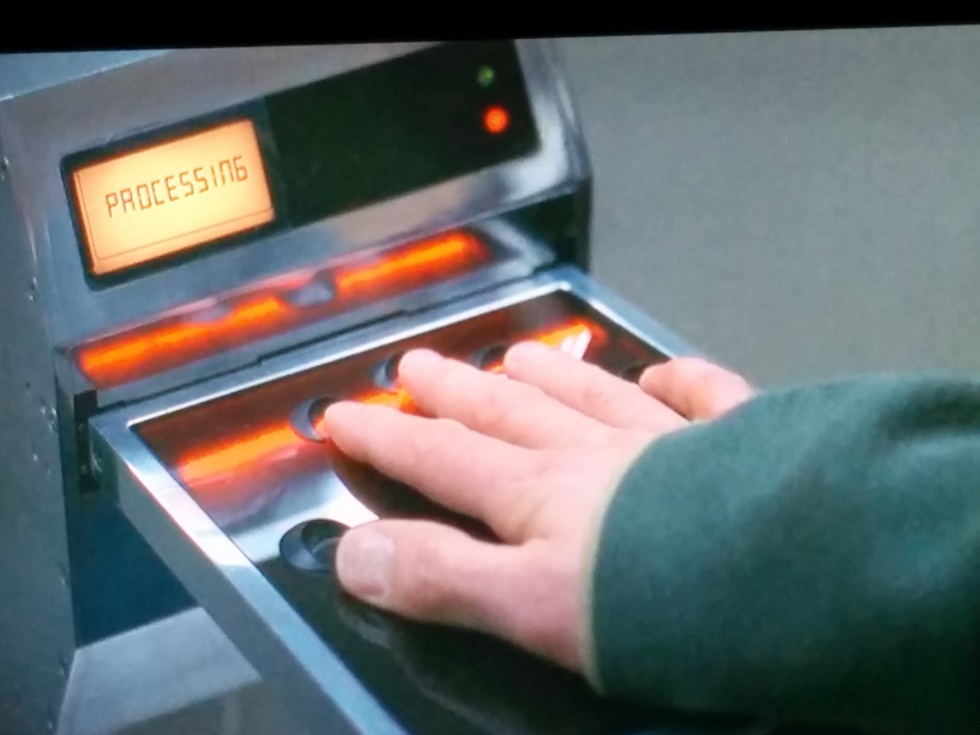 |
| State-of-the-art security for the "MIT Biomedical Research Facility" Alternate caption: I spent a weekend building this prop, and they used it for 4 seconds of footage. Fox Broadcasting Corp. |
The writers have also presaged the warm-liquid-goo-phase meme from Austin Powers, as the antidote to the freezing catalyst seems to be epinephrine, DMSO, electroshock...and complete-body immersion in a human-sized deep fryer:
 |
| Warm liquid goo phase - Complete! Fox Broadcasting Corp. |
Spoiler alert - the concluding scene, a conflagration in the "MIT computer mainframe," would likely have set the Schrock and Buchwald groups back quite a number of years.
Finally, I'll leave you with a silly futuristic quote: "The technology to engineer [Compound X] is still 5, 10 years away..." Sorry, Dr. Lisa - it's been 23 years since this episode aired, and to my knowledge, we're still not making per-heliated small molecules. Maybe check back in another three decades.
--
If you enjoyed this post, try some of the others in the Chemistry Movie Carnival from 2013.
Sunday, November 29, 2015
Molten Salt Bath, Anyone?
While paging through Organic Reactions, Vol 1 in the chemistry library*, I encountered some unusual conditions in a review of the Elbs reaction. If you're not familiar, it's a high-temperature pyrolysis** of ortho-tolyl ketones to produce polycyclic aromatic hydrocarbons (PAHs). Products produced from the reaction find use as analytical standards for oil processing, in studies of DNA intercalation, and as molecular wires.
As alluded to above, the chemistry itself wasn't what caught my attention, but rather this sentence:
I realize that pyrolysis technologies have advanced in 70 years' time - FVP permits higher temperatures for much shorter residence times - but the concept of a molten mixture of sodium nitrate and potassium nitrite seemed both dangerous and alluring.
Looking through SciFinder, it seems that molten salt baths still find regular use in case-hardening and nitriding of steelwork, along with applications in cleaning organic residues off polymer extrusion dies. For extreme data-philes, the Molten Salts Research Center thoroughly analyzed a variety of salt mixture properties in a 150-page reference. Park Thermal International has published what seems to be a very conservative safety manual for nitrate-nitrite baths, and with good reason: aluminized leather aprons, tinted visors, and gauntlets help protect workers from glowing pools of salts at temperatures just below "decomposition...with extreme explosive violence."
Though I've never worked with molten salts, that doesn't mean none of my readers have. I see Milkshake has softened a 2L round-bottom flask by heating up to 380 with a graphite flake dry bath. How about you, Chemjobber?
Or are molten salt baths potential entrants in Derek's "Things I Won't Work With"?
Update (29 Nov): A commenter points out some previous Milkshake high-T campaigns.
--
*Real books! Complete with yellowing pages, musty smells, and indexes full of names like Fuson, Fieser, and Bachmann.
**Can't get enough Elbs? Curious readers are directed to Name Reactions for Carbocyclic Ring Formations, 2010, Jie Jack Li and Timothy T. Curran. Review starts on p. 324.
***Obviously not counting use of a butane torch to pull pipettes, heat sieves and salts, etc.
 |
| PAH prepared by heating at 500 oC Bonus: Roman numerals in older reviews? Classy, but confusing. Source: Organic Reactions 1, p. 154 |
"The flask is charged with 152 g of the crude ketone and heated in a nitrate-nitrite bath (care!) at 430 ± 5 oC."Four hundred degrees! During all my years in lab, I can't remember heating reactions past about 300, and those were with machined blocks of aluminum on an ancient Thermo hotplate.***
I realize that pyrolysis technologies have advanced in 70 years' time - FVP permits higher temperatures for much shorter residence times - but the concept of a molten mixture of sodium nitrate and potassium nitrite seemed both dangerous and alluring.
 |
| This is either Hawaii's Mt. Kilauea, or a molten salt bath. Or both. Source: thelandofshadow.com |
Looking through SciFinder, it seems that molten salt baths still find regular use in case-hardening and nitriding of steelwork, along with applications in cleaning organic residues off polymer extrusion dies. For extreme data-philes, the Molten Salts Research Center thoroughly analyzed a variety of salt mixture properties in a 150-page reference. Park Thermal International has published what seems to be a very conservative safety manual for nitrate-nitrite baths, and with good reason: aluminized leather aprons, tinted visors, and gauntlets help protect workers from glowing pools of salts at temperatures just below "decomposition...with extreme explosive violence."
Though I've never worked with molten salts, that doesn't mean none of my readers have. I see Milkshake has softened a 2L round-bottom flask by heating up to 380 with a graphite flake dry bath. How about you, Chemjobber?
Or are molten salt baths potential entrants in Derek's "Things I Won't Work With"?
Update (29 Nov): A commenter points out some previous Milkshake high-T campaigns.
--
*Real books! Complete with yellowing pages, musty smells, and indexes full of names like Fuson, Fieser, and Bachmann.
**Can't get enough Elbs? Curious readers are directed to Name Reactions for Carbocyclic Ring Formations, 2010, Jie Jack Li and Timothy T. Curran. Review starts on p. 324.
***Obviously not counting use of a butane torch to pull pipettes, heat sieves and salts, etc.
Friday, July 17, 2015
Friday Potpourri: MegaMan, Lab Coats, More Worms
 Please excuse my general lack of posting. When "Big Work Project" finally wraps, I'll have a bit more time for chemistry frivolity. In the meantime, how about a little collection of almost-posts to help you into your weekend?
--
Faculty Fun: Maintaining a list of faculty moves can be tedious, but sometimes you find little gems on group pages. For example, Jeff Rinehart's group at UCSD will study magnetic materials. The logical mascot? A MegaMan master robot! (Vittorio would be so pleased...)
--
Last month, thought-provoking Chemistry World columnist Philip Ball wrote about white lab coats as badges of professional scientific stature. You may recall that one of my first posts here at JLC referred to the many ways in which such a white coat could be spoiled. I'm not exactly certain why - supplier availability, fire resistance, styling, cheaper? - but chemists in some younger synthetic organic chemistry groups seem to prefer blue lab coats.
Need evidence? Click below:
Phil Baran group
Stephenson group
Meek group
Shenvi group
(Readers: Know of more indigo-hued groups? Please mention in the comments)
--
Finally, for fans of vermisynthesis (who isn't?), you may notice that the chemblogosphere is giggling about this recent Tetrahedron paper on catalytic earthworms. Quintus points back to a 2014 PLoS One, but how far back have chemists truly considered the lowly earthworm as synthetic feedstock? Professor Leonardo Santos of the University of Talca, Chile, has investigated bioreduction of beta-carbolines since at least 2013. Perhaps he was inspired by the work of Kohji Ishihara, who published similar reductive behavior in cell-free worm extracts back in 2006. And both should potentially thank D.Q. Keiline, a reference in Ishihara's manuscript, who back in 1920 published "On the pharyngeal or salivary gland of the earthworm," which portended some of the proteolytic enzymes found therein.
 |
| Worm salivary glands (s.gl. in picture). You're welcome. Source: Keiline, 1920 |
Tangentially, it's worth noting that an engineer in Colombia recently commercialized "biofilters" made of (living) earthworms, which clean organic solids from waste water. Seems someone should take a harder look at the potential catalytic goldmines wriggling underfoot.
Happy, squirmy Friday, everyone!
See Arr Oh
Tuesday, June 16, 2015
How Long are Postdoctoral Fellowships?
For a better analysis with more data, click here.
OK, apologies, chemblogosphere: today is apparently write-guest-posts-for-Chemjobber day.
He poses an interesting question in his "Ivory Filter Flask" post from earlier today:
" What is the median length of a postdoc these days, anyways?"
Well, I may have some answers to that question. Looking through the New Hires, I put together a list, and ran some basic statistics*:
MIN: 1 year
MAX: 8 years
(n = 38)
It's tough to make general statements about such a small cohort, but I noticed two trends:
1) Disciplines such as chemical biology, nanomaterials, P-chem, and computational chemistry tended to stay in longer postdocs.
2) About 20% of the faculty profiles were in more than one postdoc or other fellowship program prior to their faculty appointment.
Thoughts? Sound right, or wrong? Please let me know in the comments!
--
*Caveats:
These postdocs reflect pending faculty appointments; I'm clearly not counting those who went into government, pharmaceutical, industry, or left chemistry entirely. If someone has a good idea for how to capture that data, I'm all ears.
Counting time: If someone gave a graduation year - "Ph.D. 2009"- I assumed a postdoctoral stint until their faculty start date. For example, 2015 start = 6 years a postdoc. If, however, they provided a range - "postdoc 2012-2014" - I assumed that they postdoc'd the difference of that time, or 2 years, despite the fact that, depending on start and end dates, that could reasonably be interpreted as any length of time between 13 months (Dec 2012-Jan 2014) and 36 months (Jan 2012-Dec 2014).
Of the 73 new faculty starting in 2015 or 2016 (as of June 2015), I was only able to find bio-sketch information for half. The following people from my list are represented in the above statistics: Li, Engle, Hyster, Matson, Menard, Personick, Thoi, Tsui, Wasa, Blakemore, Browne, Devery, Gahlmann, Kempa, Limmer, Nelson, Sing, Thompson, Bantz, Hubbard, Garcia-Bosch, Huo, Wei Li, Miller, Rossini, Seiple, Wu, Anand, Boudreau, Genereux, Jiang, Sletten, Theberge, Fu, Ke, Conley, Raston.
OK, apologies, chemblogosphere: today is apparently write-guest-posts-for-Chemjobber day.
He poses an interesting question in his "Ivory Filter Flask" post from earlier today:
" What is the median length of a postdoc these days, anyways?"
Well, I may have some answers to that question. Looking through the New Hires, I put together a list, and ran some basic statistics*:
| MEAN: | 3.7 years |
| MODE: | 3 years |
| MEDIAN | 4 years |
MAX: 8 years
(n = 38)
It's tough to make general statements about such a small cohort, but I noticed two trends:
1) Disciplines such as chemical biology, nanomaterials, P-chem, and computational chemistry tended to stay in longer postdocs.
2) About 20% of the faculty profiles were in more than one postdoc or other fellowship program prior to their faculty appointment.
Thoughts? Sound right, or wrong? Please let me know in the comments!
--
*Caveats:
These postdocs reflect pending faculty appointments; I'm clearly not counting those who went into government, pharmaceutical, industry, or left chemistry entirely. If someone has a good idea for how to capture that data, I'm all ears.
Counting time: If someone gave a graduation year - "Ph.D. 2009"- I assumed a postdoctoral stint until their faculty start date. For example, 2015 start = 6 years a postdoc. If, however, they provided a range - "postdoc 2012-2014" - I assumed that they postdoc'd the difference of that time, or 2 years, despite the fact that, depending on start and end dates, that could reasonably be interpreted as any length of time between 13 months (Dec 2012-Jan 2014) and 36 months (Jan 2012-Dec 2014).
Of the 73 new faculty starting in 2015 or 2016 (as of June 2015), I was only able to find bio-sketch information for half. The following people from my list are represented in the above statistics: Li, Engle, Hyster, Matson, Menard, Personick, Thoi, Tsui, Wasa, Blakemore, Browne, Devery, Gahlmann, Kempa, Limmer, Nelson, Sing, Thompson, Bantz, Hubbard, Garcia-Bosch, Huo, Wei Li, Miller, Rossini, Seiple, Wu, Anand, Boudreau, Genereux, Jiang, Sletten, Theberge, Fu, Ke, Conley, Raston.
Scientific Phone Interview 101
Chemjobber has a post today asking for advice to improve success during phone interviews for scientific positions. As someone who's had to dip a toe in the interview stream several times in the past 5 years (and now routinely conducts phone interviews to fill openings in my department), I have some tips to add to CJ's arsenal:
1. (1 week prior) - Prepare.
3. (10 minutes before) - Relax.
4. (during) - Present.
1. (1 week prior) - Prepare.
- As CJ points out, know who you'll be speaking with, and a rough idea of their backgrounds. Any public source is fair game: LinkedIn, SciFinder, Mendeley, etc. Bonus: If the lead interviewer has recently published something germane to the position, download the paper and see if you can piece together what they were trying to do.

- Learn something about the company. Small, large? Private, public? Start-up? About how many people? Where do you fit in?
- Can you prove you're the candidate for the job, sight unseen? Break down the job description into chunks, and match with your skills. This may sound hokey, but literally grab a sheet of paper, divide into two columns "What they want" | "What I have" and begin filling them in. Gaps? Be sure to explain how you'll address them.
- If you don't have one, now's a great time to write up a Research Summary. Don't know how? It's easy! Condense each project you've worked on into one (1) synthetic scheme or graphic, with a plain-language description of no more than 2-3 sentences below. What were we trying to achieve? How did we do it? What did we learn?
- Go over the information from Step 1.
- Make sure you know your own CV / resume. Again, this sounds silly, but the recruiter may ask about anything you've listed, including something you don't think matters for the position in question: "Why did you choose that particular school? In Chem 257, did you happen to cover [my favorite reaction]? Tell me more about that volunteer gig from 5 years ago."
- Eat a good meal, get some sleep. In the morning, get ready as if you were attending an on-site interview. Say some lines to yourself in the mirror: "Hi, I'm Casey Smith, from Big State University. I'm really excited for this opportunity." Practice answering a few standard questions for yourself: Where do you want to be in five years? What do you know about the job or company? How have your skills and coursework prepared you to take this job?
3. (10 minutes before) - Relax.
- Briefly review the Step 1 materials. By this point, they should be condensed into a short crib sheet.
- Print out your CV / resume, so you can write things in the margins and understand what the interview team is looking at during the call.
- Have a glass of water, clear your throat. Walk around or pace if it makes you feel better.
- Be prepared to receive the call from 5 minutes early to 5 minutes late. Phone connections are tricky things, so be prepared in case you cut out (or the interviewer does). If you do not hear from them, be prepared to send an email that apologizes and requests a follow-up in the next 1-2 days.
4. (during) - Present.
- Phone interviews are increasingly conducted "by committee;" don't be surprised if you end up on a conference line with 4 people. It's considered polite for the hiring company to introduce the call by introducing the people in the room and reiterating (briefly) the job description.
- Politeness always. Please and thank you go a long way.
- You should at this point know how to answer 80% of the questions your interviewer will ask, because you've already answered them for yourself. Experience? CV. Where you want to be in 5 years? Gap analysis - see Step 1. What you've done? Research Summary.
- Take shorthand notes off to one side, because at some point, they'll ask if you have any questions. You MUST have at least one question! This shows interest in the position and a willingness to engage the speaker.
- Unless...your question is about an "HR" issue: pay, vacation, benefits, etc. Don't ask about these; you'll have a chance during the on-site.
- Always send a thank-you email to acknowledge the interviewers' time and preparation, and be prepared for them to ask for further information.
That's it. Good luck!
Friday, March 6, 2015
#MyBigBreak Blog Carnival
Over at his place, Chemjobber has (unbeknownst to him, but knownst to us) begun a Blog Carnival around the topic of lucky employment breaks. Here's mine, albeit edited to protect names of the innocent...
My Freshman year at Big State University passed unceremoniously, as many do. Made lots of cultural and personal adjustments. Some courses aced, some classes ignored, all in pursuit of a major I thought I enjoyed. Enter Sophomore year, when I had the standard eye-opening, life-altering epiphany all self-identified organikers have upon taking O-Chem 201. But that's not where My Big Break(TM) occurred.
Fast forward to the weekly Chem Colloquium, in which speakers from the outside world came in to advise we burgeoning chemists how life looked on the other side of college. Once, a wild-haired, soft-spoken gentleman visited from the Big City. He worked in pharmaceutical chemistry, and I'll never forget something he said at the end of his talk: "Interns Wanted." Yes, we were being pitched to finish his presentation! At that moment, years of summer toil checking bags, cleaning parking lots, mopping floors, updating registers,* sharpening pencils*, and preparing transparencies* paled in comparison to WORKING IN BIOTECH. I somehow bulled my way to the front of the lecture hall in time to grab the last open slot on his roster.
The rest, as they say, is history...--
*This was before the Internet, tablet PCs, and wide adoption of PowerPoint. Ask your parents.
Monday, December 29, 2014
"Gatekeeping" in Intro Chem Lab
Over at Chemjobber, there's an interesting discussion around "gatekeeping" - intentionally using introductory science courses as weed-outs to restrict access to higher-level material - and whether anyone actually does this in practice. Although I don't think of my experience in these terms, I'll relate my recollections and let readers judge for themselves.
 |
| Stone walkway, 2014 |
At Big State University, I was part of a teaching assistant (TA) team tackling Chemistry 101 lab. These were classic experiments: density, dilutions, diffracting light, quantitative analysis, titrations, measuring exotherms. TAs not only ran labs, but lectured beforehand, graded reports, filled out student evaluations, and tallied final grades.
While the content wasn't enough to weed out dedicated students, the lab policies certainly may have been. The implied ideology went: "if you can't follow these rules now, you'll never cut the higher-level labs."
Pass in a report 1 minute past the start of lecture? Zero.
Handwritten report? Zero.
Blatant disregard for lab equipment? Zero.
Show up to lab without proper PPE? Go home.
If a student had not replaced broken glassware by semester's end? Fail.
Evidence of plagiarism from the lab manual or suspected from others' reports? Fail.
Miss the final exam? (Yes, a final lab exam...) Fail.
Though the TAs tried valiantly to corral teach the ~400 students who came through our section each semester, my honest memory was that we usually kept fewer than 250 by term's end.
Thursday, December 25, 2014
Merry Christmas | Happy Thursday
Merry Christmas to my wonderful, interactive, patient readers. It's been a great year over here.
(If Christmas isn't something you celebrate, happy Thursday!)
If you're looking for something holiday-themed - and don't feel like resorting to Google - try these:
Chemistry of Tinsel
Chemistry of Snowflakes
Chemical Aroma of Christmas Trees
Holiday Organic Synthesis
A Chemjobber Tradition - The Letter Home
ScienceGeist's Chemistree
I have a long week coming up, and a merry backlog of topics to write about.
More posts forthcoming!
Dona nobis pacem,
See Arr Oh
(If Christmas isn't something you celebrate, happy Thursday!)
If you're looking for something holiday-themed - and don't feel like resorting to Google - try these:
 |
| Look, I made the tree this year! |
Chemistry of Snowflakes
Chemical Aroma of Christmas Trees
Holiday Organic Synthesis
A Chemjobber Tradition - The Letter Home
ScienceGeist's Chemistree
I have a long week coming up, and a merry backlog of topics to write about.
More posts forthcoming!
Dona nobis pacem,
See Arr Oh
Tuesday, July 29, 2014
Takei's Target Audience
George Takei, an American actor / activist perhaps most famous as "Sulu" from Star Trek, inadvertently let slip a fantastic bit of advice to Terry Gross on Fresh Air (emphasis mine):
Just replace "equality for the LGBT community" with "chemistry for the general public," and you stumble on a very familiar problem in the blogosphere; communication to that "vast middle" is something we ponder every day.
 |
| Takei: outreach specialist, helmsman |
"I've been on speaking tours advocating for equality for the LGBT community. But what we noticed was I was already talking to the converted — either LGBT people or allies — and what we needed to do was reach what I maintain is the decent, fair-minded, vast middle — people who are busy pursuing their lives and don't stop to think about other issues."
Just replace "equality for the LGBT community" with "chemistry for the general public," and you stumble on a very familiar problem in the blogosphere; communication to that "vast middle" is something we ponder every day.
Sunday, July 20, 2014
Review: ChemBioDraw 14.0
Dear ChemBioDraw* Ultra 13.0,
Listen, we had a good run together. But I've fallen for another: ChemBioDraw Ultra 14.
My good friends at PerkinElmer (PKI) were kind enough to grant me trial access to their spiffy new chemistry drawing software. As an avid user since, oh, say, ChemDraw Pro 4.5, I feel confident in stating that this version wins all around for smoother operation, better templates, easier file export, and better shortcut keys.
So, I figured what PKI really wanted me to do most was to try and BREAK ChemBioDraw 14.0
. . .if I could. Did I succeed? Let's talk a walk through the software and find out.
Starting at the top, I figured I'd check the "What's New?" link in the help menu. One thing I appreciated more than I thought? ChemBioDraw 14.0 directing "Help" queries into the appropriate section of the User Guide. Version 13 still spawned its help window inside Windows help, with the infamous purple booklets leading you down wild goose chases of clunkily-presented information.
Drawing hasn't changed much since 13.0. At least the text direction auto-correct -- which drove me batty in former iterations -- seems to have been tweaked; the system now opens my older drawings the way I typed 'em in originally (hence, below, attaching pasta sauce to a scaffold in place of a sugary placeholder).
The CBD 14.0-to-SciFinder jump works much more smoothly than I had anticipated. For those of us who shuddered through dial-up desktop versions of SciFinder in the late '90s, this version feels like the sleek Lamborghini of the search world. After drawing (or importing) my structures of choice, I lassoed them up and pressed the little "SciFinder diamond" on the top toolbar. Within about 5 seconds, a new window opened with the standard exact / substructure motif. Two clicks later, I'd be deep into the primary literature.
So, my goal was to break the system, right? Here's a logical place to try - I attempted to load each and every complex structure I had drawn since starting my fledgling blogger's career, around 2009 or thereabouts. Again, I was amazed by the speed and accuracy of the SciFinder pop-out, which returned roughly 90% of the correct molecules I'd searched for (below):
However, it's not all bubbles and sunshine. Two of my molecular queries bore no fruit**; perhaps they're too new to have been uploaded into CAS's databases yet. But one thing remains tricky: drawing and searching for metallocenes. Along with their new push into biology clip art, ChemBioDraw has a renewed focus on making sure you've got those sandwich compounds properly aligned.

Now, even after aligning my query using the proper template, SciFinder makes a mess out of it.
So, obviously I went looking for things to break, and found some rather limited examples. Honestly? The rest of the program works pretty well. And writing this review gave me a wonderful opportunity to poke and prod at the product in ways I hadn't in far too long.*** I finally realized you could change the solvent on the NMR predictor! I played around with expanding and collapsing peptide and RNA strings. And the post-drawing mods to more complex peptides, like disulfide and lactam cross-linking? Much better.
I will take this final moment to remember a long-lost piece of ChemDraw lore. Once upon a time, to "clean up" one's structures, the icon looked something like this (right). I've heard it referred to as a jellyfish, a squid, a broom (no!), but I always knew it as a friendly little octopus. With CBD 14, any doubt about its brushiness has been cast aside with a full-out icon redesign.
Looks great, guys. Now let me think about more ways to use it for actual work!
*For other blog reviews of ChemDraw products, see Jess The Chemist, Andre the Chemist (no relation), or Chemjobber.
**Here's the structures that returned empty SciFinder searches. Both compounds (left, right) were first reported in 2014.

***P.S. I never knew you openly solicited beta testers for these products...gimme a call sometime, PKI!
Listen, we had a good run together. But I've fallen for another: ChemBioDraw Ultra 14.
My good friends at PerkinElmer (PKI) were kind enough to grant me trial access to their spiffy new chemistry drawing software. As an avid user since, oh, say, ChemDraw Pro 4.5, I feel confident in stating that this version wins all around for smoother operation, better templates, easier file export, and better shortcut keys.
So, I figured what PKI really wanted me to do most was to try and BREAK ChemBioDraw 14.0
. . .if I could. Did I succeed? Let's talk a walk through the software and find out.
 |
| CBD 14.0 means NEVER seeing this screen again (hooray!) |
Drawing hasn't changed much since 13.0. At least the text direction auto-correct -- which drove me batty in former iterations -- seems to have been tweaked; the system now opens my older drawings the way I typed 'em in originally (hence, below, attaching pasta sauce to a scaffold in place of a sugary placeholder).
 |
| I promise this made sense in earlier ChemDraw versions... |
The CBD 14.0-to-SciFinder jump works much more smoothly than I had anticipated. For those of us who shuddered through dial-up desktop versions of SciFinder in the late '90s, this version feels like the sleek Lamborghini of the search world. After drawing (or importing) my structures of choice, I lassoed them up and pressed the little "SciFinder diamond" on the top toolbar. Within about 5 seconds, a new window opened with the standard exact / substructure motif. Two clicks later, I'd be deep into the primary literature.
So, my goal was to break the system, right? Here's a logical place to try - I attempted to load each and every complex structure I had drawn since starting my fledgling blogger's career, around 2009 or thereabouts. Again, I was amazed by the speed and accuracy of the SciFinder pop-out, which returned roughly 90% of the correct molecules I'd searched for (below):
 |
| From this 2011 post |
 |
| From this 2013 post |
 |
| From this 2014 post |
 |
| Sigh. If only I remembered what they were all supposed to be... |
Now, even after aligning my query using the proper template, SciFinder makes a mess out of it.
 |
| From this 2012 post |
So, obviously I went looking for things to break, and found some rather limited examples. Honestly? The rest of the program works pretty well. And writing this review gave me a wonderful opportunity to poke and prod at the product in ways I hadn't in far too long.*** I finally realized you could change the solvent on the NMR predictor! I played around with expanding and collapsing peptide and RNA strings. And the post-drawing mods to more complex peptides, like disulfide and lactam cross-linking? Much better.
 |
| Found on p. 126 of the User Guide. (Get it?) I'd like to shake the hand of the person who slipped this in... |
 |
| R.I.P., Optimizing Octopus |
I will take this final moment to remember a long-lost piece of ChemDraw lore. Once upon a time, to "clean up" one's structures, the icon looked something like this (right). I've heard it referred to as a jellyfish, a squid, a broom (no!), but I always knew it as a friendly little octopus. With CBD 14, any doubt about its brushiness has been cast aside with a full-out icon redesign.
Looks great, guys. Now let me think about more ways to use it for actual work!
Thanks again to Philip Skinner and PerkinElmer for the chance to review the software.
---*For other blog reviews of ChemDraw products, see Jess The Chemist, Andre the Chemist (no relation), or Chemjobber.
**Here's the structures that returned empty SciFinder searches. Both compounds (left, right) were first reported in 2014.
Sunday, August 18, 2013
Link Farm: Chemistry Communication
Blogs, like any medium, shift, change, and grow over time. At first, I devoted my humble corner of the internet to food chemistry. After a while, it became a tool to root out misconceptions about chemistry in popular culture.
Well, to borrow a phrase from Click and Clack, I've come around for the "third half of the show" - figuring out how to bridge the gap between the growing public desire for accessible, informative, entertaining science content and chemistry's approach to that communication. A lot of terms have swirled around this issue: "punching down," #BogusChem, "Inside Baseball," 'in-reach' not outreach, #chemophobia, and "dumbing down," to name just a few.
This post will serve as a (growing) collection of pieces dedicated to thoughtful chemistry outreach.
Readers: Have a favorite post I haven't included? Send it along in the comments.
Janet Stemwedel, Doing Good Science: "When we target chemophobia, are we punching down?"
Chad Jones, The Collapsed Wavefunction: "Punching down? I don't remember swinging at all."
Ash Jogalekar, The Curious Wavefunction: "Where's the chemistry lobby? On why we need a National Center for Chemical Education."
See Arr Oh, Just Like Cooking: "The Chemistry Popularity Conundrum"
Michelle Francl, Slate: "Don't Take Medical Advice from the NY Times Magazine"; Nature Chemistry: "How to counteract chemophobia";
Paul Bracher, ChemBark: "Combatting Chemophobia"
Rebecca Guenard, Atomic-O-Licious: "Chemistry Isn't Just About Chemicals"
Science 2.0: "Chemophobia - The Unnatural Fixation of Activists"
Chemjobber, Dr. Rubidium, See Arr Oh, Chemjobber: "Chemistry Avengers" (podcast)
Marc Leger, Atoms and Numbers: "Consider the audience when addressing chemophobia"
Chris Clarke, Pharyngula: "Did you know douchebags are full of dihydrogen monoxide?"
Andrew Bissette, Behind NMR Lines: "In defense of #chemophobia"
More to come...
Well, to borrow a phrase from Click and Clack, I've come around for the "third half of the show" - figuring out how to bridge the gap between the growing public desire for accessible, informative, entertaining science content and chemistry's approach to that communication. A lot of terms have swirled around this issue: "punching down," #BogusChem, "Inside Baseball," 'in-reach' not outreach, #chemophobia, and "dumbing down," to name just a few.
 |
| Thanks for the tip about the magnets, Andre! (P.S. Yes, I know "D" isn't an element) |
Readers: Have a favorite post I haven't included? Send it along in the comments.
Janet Stemwedel, Doing Good Science: "When we target chemophobia, are we punching down?"
Chad Jones, The Collapsed Wavefunction: "Punching down? I don't remember swinging at all."
Ash Jogalekar, The Curious Wavefunction: "Where's the chemistry lobby? On why we need a National Center for Chemical Education."
See Arr Oh, Just Like Cooking: "The Chemistry Popularity Conundrum"
Michelle Francl, Slate: "Don't Take Medical Advice from the NY Times Magazine"; Nature Chemistry: "How to counteract chemophobia";
Paul Bracher, ChemBark: "Combatting Chemophobia"
Rebecca Guenard, Atomic-O-Licious: "Chemistry Isn't Just About Chemicals"
Science 2.0: "Chemophobia - The Unnatural Fixation of Activists"
Chemjobber, Dr. Rubidium, See Arr Oh, Chemjobber: "Chemistry Avengers" (podcast)
Marc Leger, Atoms and Numbers: "Consider the audience when addressing chemophobia"
Chris Clarke, Pharyngula: "Did you know douchebags are full of dihydrogen monoxide?"
Andrew Bissette, Behind NMR Lines: "In defense of #chemophobia"
More to come...
Tuesday, August 13, 2013
Podcast: Chemjobber, Stu, and SAO Discuss Plagiarism (Part 1)
Way back in February, Chemjobber and I sat down with Stuart Cantrill, Chief Editor of Nature Chemistry, for a chat about plagiarism in scientific publishing. We had so much fun talking that the recording ballooned into a 2-h epic podcast; I didn't know where to start editing!
Mea culpa - the conversation languished on my desktop, and I made excuses each week not to get it done.
Finally, Part 1 of the CJ / SC / SAO "Epic Podcast" arrives!
0:07 - Special guests
1:29 - Stu's day job: What happens to papers submitted to Nature Chem?
4:29 - How do you define #1?
8:19 - "Actually, actually, actually..."
10:42 - Journals already use plagiarism-checking software!?!
12:10 - (and get way too many submissions)
16:22 - Cantrill, automated.
18:47 - Who bears the cost of plagiarized papers?
22:50 - CJ's curious: What happens to the person caught copying?
28:12 - The self-correcting scientific literature
28:58 - Bloggers: A small group of people who care too much...
30:17 - Why publish or perish? Shouldn't it be quality, not quantity?
32:09 - Indexes (Indices?)
33:18 - Opening the door to Hour 2...
P.S. - If you need a primer, the earlier podcast CJ and I refer to is here.
Mea culpa - the conversation languished on my desktop, and I made excuses each week not to get it done.
Finally, Part 1 of the CJ / SC / SAO "Epic Podcast" arrives!
0:07 - Special guests
1:29 - Stu's day job: What happens to papers submitted to Nature Chem?
4:29 - How do you define #1?
8:19 - "Actually, actually, actually..."
10:42 - Journals already use plagiarism-checking software!?!
12:10 - (and get way too many submissions)
16:22 - Cantrill, automated.
18:47 - Who bears the cost of plagiarized papers?
22:50 - CJ's curious: What happens to the person caught copying?
28:12 - The self-correcting scientific literature
28:58 - Bloggers: A small group of people who care too much...
30:17 - Why publish or perish? Shouldn't it be quality, not quantity?
32:09 - Indexes (Indices?)
33:18 - Opening the door to Hour 2...
P.S. - If you need a primer, the earlier podcast CJ and I refer to is here.
Friday, June 28, 2013
WWWTP? "Tristillation?" Not So Fast, Zarco
A goofy, over-the-top marketing campaign for Zarco* tequila made its Twitter rounds yesterday (thanks, David Perry, ChemBark, and Chemjobber!).
Here's the company's video, titled "Tristillation (TM) Explained." I can't succinctly explain all the goofy pseudo-science in one fell swoop, so I'll just go second by second.
0:01 - Welcome to Zarco! Why, oh why, does everyone believe labs need a blinding hospital-white color scheme?
0:03 - Do you usually use a light microscope to examine molecules? I certainly don't.
0:04 - That retort in the background is boiling away, but there's NO FLAME underneath it (?!?)
0:06 - When's the last time you used a separatory funnel to isolate your distillate?
0:11 - Laymen's terms - Dear Zarco: Distillation doesn't work like that! The crude fermentation isn't sitting there in some sort of "pre-alcohol" waiting for you to add heat. When you distill, you're purifying the ethyl alcohol (their 'C-two-H-five-Oh-H') away from the water.
Ye Gods.
0:17 - A third undiscovered 'element' - this part is so inane I forgot to laugh. Short answer: no.
0:22 - Chemetron Medical products collection jar in the background. That's a plastic autoclave bottle; I'd never use it for this.
There's a few other videos save on their YouTube portal, Highlights include near-complete lack of gloves, goggles, or other safety equipment, and (chuckle) a background reflux condenser, which you'd actually use to distill something, sitting abandoned on a clamp.
I get the kitschy, comedic sci-fi vibe Zarco was going for, but they'd better hope their target audience isn't science literate. I can't get past the stupid long enough to buy a bottle.
*Does it bother anyone else that "Zarco" sounds like Darco, the fine activated carbon powder we actually DO use in lab? (to remove colors from solutions)
Here's the company's video, titled "Tristillation (TM) Explained." I can't succinctly explain all the goofy pseudo-science in one fell swoop, so I'll just go second by second.
0:01 - Welcome to Zarco! Why, oh why, does everyone believe labs need a blinding hospital-white color scheme?
0:03 - Do you usually use a light microscope to examine molecules? I certainly don't.
0:04 - That retort in the background is boiling away, but there's NO FLAME underneath it (?!?)
0:06 - When's the last time you used a separatory funnel to isolate your distillate?
0:11 - Laymen's terms - Dear Zarco: Distillation doesn't work like that! The crude fermentation isn't sitting there in some sort of "pre-alcohol" waiting for you to add heat. When you distill, you're purifying the ethyl alcohol (their 'C-two-H-five-Oh-H') away from the water.
Ye Gods.
0:17 - A third undiscovered 'element' - this part is so inane I forgot to laugh. Short answer: no.
0:22 - Chemetron Medical products collection jar in the background. That's a plastic autoclave bottle; I'd never use it for this.
There's a few other videos save on their YouTube portal, Highlights include near-complete lack of gloves, goggles, or other safety equipment, and (chuckle) a background reflux condenser, which you'd actually use to distill something, sitting abandoned on a clamp.
I get the kitschy, comedic sci-fi vibe Zarco was going for, but they'd better hope their target audience isn't science literate. I can't get past the stupid long enough to buy a bottle.
*Does it bother anyone else that "Zarco" sounds like Darco, the fine activated carbon powder we actually DO use in lab? (to remove colors from solutions)
Sunday, June 16, 2013
What's Important? Data Analysis
Thanks again to everyone who wrote in with their two (or three) most important job criteria.
We had a final tally of 42 (!) respondents, who gave a total of 94 answers. Here's the much-vaunted pie chart I promised on Friday:

Comments:
1. Many people wanted "meaning" behind their daily work. There're a lot of terms one could use to describe that special feeling of fulfillment - they're all included in the largest pie wedge.
2. Only a tenth of you indicated salary or benefits as part of your criteria. Two percent mentioned promotions or advancement. Shocking, really, especially in a down economy.
3. The "Misc" category included responses such as autonomy, lack of bureaucracy, morality, health, and...free food.
4. Prediction: If I offered a 5-year job working on cures for neglected diseases, starring top-flight, team-oriented colleagues located 10 minutes down the street from your house, most of you would take it.
Right?
So, in the end, have we vindicated Mr. Sturgeon's beliefs about modern science workers? I believe we have. Interesting work and collegiality really do seem to matter most!*
*Limitations: Now, this only surveyed 42 chemists, so I'm missing out on the other 90,858. I'm well aware that the survey only caught 1) chemists reading blogs, 2) chemists on Twitter, and 3) chemists who could comment on blogs during (presumably) working hours. Not exactly perfect conditions for such a study. My 'analysis,' such as it was, had no tests for accuracy, and no way to filter out trolls. C'est la vie.
Challenge: I'd love to see this survey writ large...wouldn't you? Perhaps a larger journal or scientific society could issue the survey to their members (lookin' at you, ACS, Science...).
Readers: Questions, comments? Feel free to contact me (Seearroh_AT_gmail).
We had a final tally of 42 (!) respondents, who gave a total of 94 answers. Here's the much-vaunted pie chart I promised on Friday:
Comments:
1. Many people wanted "meaning" behind their daily work. There're a lot of terms one could use to describe that special feeling of fulfillment - they're all included in the largest pie wedge.
2. Only a tenth of you indicated salary or benefits as part of your criteria. Two percent mentioned promotions or advancement. Shocking, really, especially in a down economy.
3. The "Misc" category included responses such as autonomy, lack of bureaucracy, morality, health, and...free food.
4. Prediction: If I offered a 5-year job working on cures for neglected diseases, starring top-flight, team-oriented colleagues located 10 minutes down the street from your house, most of you would take it.
Right?
So, in the end, have we vindicated Mr. Sturgeon's beliefs about modern science workers? I believe we have. Interesting work and collegiality really do seem to matter most!*
*Limitations: Now, this only surveyed 42 chemists, so I'm missing out on the other 90,858. I'm well aware that the survey only caught 1) chemists reading blogs, 2) chemists on Twitter, and 3) chemists who could comment on blogs during (presumably) working hours. Not exactly perfect conditions for such a study. My 'analysis,' such as it was, had no tests for accuracy, and no way to filter out trolls. C'est la vie.
Challenge: I'd love to see this survey writ large...wouldn't you? Perhaps a larger journal or scientific society could issue the survey to their members (lookin' at you, ACS, Science...).
Readers: Questions, comments? Feel free to contact me (Seearroh_AT_gmail).
Friday, April 26, 2013
Podcast: Deborah Blum talks to CJ and SAO, Part II
A few weeks back, Chemjobber and I spoke with esteemed science writer Deborah Blum, of Wired and Poisoner's Handbook fame, among many other things.
Half of the chat appears over at CJ's place, go have a listen!
Timepoints:
0:01 - Introduction
0:35 - Science Writing "Death Grip"
2:07 - Navigating life through science
4:45 - "Chemical-free" (oh, boy...)
8:58 - The Great Golden Day of the Newspaper
12:42 - Crowdfunding newspapers?
14:35 - Advice for new science writers: "It's a lot of fun!"
15:34 - The thousand mealworm cookies
17:38 - Now appearing at your local Kroger - insects!
Thanks again to Deb for a fantastic conversation.
Half of the chat appears over at CJ's place, go have a listen!
Timepoints:
0:01 - Introduction
0:35 - Science Writing "Death Grip"
2:07 - Navigating life through science
4:45 - "Chemical-free" (oh, boy...)
8:58 - The Great Golden Day of the Newspaper
12:42 - Crowdfunding newspapers?
14:35 - Advice for new science writers: "It's a lot of fun!"
15:34 - The thousand mealworm cookies
17:38 - Now appearing at your local Kroger - insects!
Thanks again to Deb for a fantastic conversation.
Thursday, March 28, 2013
Who Gets Hired Where?
Not to steal Chemjobber's thunder, but I can't resist the question: Does anyone know a reliable data set for industrial chemistry hiring?
Taking my cue from Paul's incredibly exhaustive list of 2013 moves and hires in the academic world, I baited Twitter with the question. CJ opined immediately, with an apt football analogy:

Snerk.
Dan weighed in with a tantalizing bon mot:

Is there a massive, unseen data set out there somewhere? [scratches chin, head...]
Straightaway, I can only think of LinkedIn, which suffers from being 1) voluntary, and 2) noisy data. Other sources might include faculty web pages (infrequently updated) or the C&EN Careers page (accurate, but limited). The ACS Employment and Salary Survey could track this, but I don't think it's granular down to the specific position and company.
Readers: Does anyone know of a better way to collect this data?
Update: CJ (correctly) points out that 'ACS Career Survey' isn't a real thing. Fixed, thanks!
Wednesday, February 20, 2013
Podcast: CJ and SAO Talk Plagiarism
After the latest Xi Yan / Dalton story broke, Chemjobber was gracious enough to sit down with me to hash out our feelings about plagiarism, peer review, and what we hoped might happen when the next batch of purloined text comes around.
Timepoints:
0:02 - Introduction
0:56 - You say "incensed," I say "attracted"
2:29 - Bogus!
3:09 - CJ steals my Great Idea
3:40 - Playing 'Editor' with SAO
5:32 - Is it true? Is it new?
7:01 - Entering the 'gray area'
8:12 - Azaspiracids: Three papers, three different intros
9:30 - Doris Kearns Goodwin
10:44 - Please don't copy word-for-word!
12:23 - Being an Asst. Professor is hard
13:55 - We need a cultural context guidebook...
15:05 - World Science - Impact Factor 35.0
16:20 - Language / Science Barriers
18:09 - Peer Review - Get 'em while they're young!
19:57 - $$ Entrepreneurial Idea! $$
21:33 - How much time do you spend reviewing?
22:45 - CJ's Dangerous Game
23:07 - Conclusions
24:32 - Bonus track
Thanks, as always, to CJ for some stimulating conversation!
Tuesday, February 12, 2013
Elsewhere...

Hey, check it out: Blog Syn #002 is live!
(And I hear that #003 is well on its way...)
More to come at JLC in the next few days. Stay tuned!
Subscribe to:
Posts (Atom)