Looks like Lake Erie wants to hurt you.
OK, not the lake itself, but the potentially toxic concentrations of cyanobacteria formed in recent record algal blooms. Yesterday, a multi-institution group of ecologists and environmental engineers reported a 'perfect storm' of runoff fertilizer, warm weather, and quiet waters in the lake that led to a marked increase in 2011 cyanobacteria populations. In fact, there appear to have been two blooms - the first Microcystia, and the second Anabena, two bacterial baddies* associated with liver and neurotoxicity. Scary stuff!
 Well, the press coverage stemming from the study hasn't calmed fears. Here's a sampling from NSF, Huffington Post, and Discover. The HuffPo title really runs the chemophobia angle:
"Lake Erie Blooms Expected to Continue, Threatening Ecosystem, People." (!!!)
They dress the presser up for the occasion, with words like noxious, toxic, ugly, hazard, and problem. Discover writes 'toxic' three times, without pointing out what the toxins are! Even the normally staid NSF jumps on the bandwagon, referring to a mysterious 'liver toxin.'
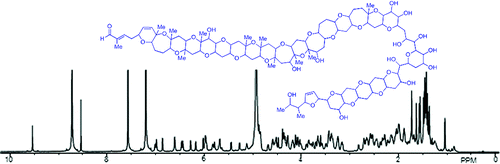
What types of toxins are we talking about? Actually, that's a bone of contention here: the researchers only mention two, microcystin and anatoxin. Those turn out to be confusing terms, since the generic names cover >80 types of different microcystins, and at least two anatoxins [A(s) and A, right]. One assumes that the scariest anatoxin (Anatoxin-A, or 'Very Fast Death Factor'), operates here, which certainly warrants concern.
But, sans information, there's a panicked sense to the releases not grounded in the published text. Both Discover and HuffPo indicate "~200x concentration" of "toxic stuff" in the cyanobacteria-enriched water. Do the researchers actually say this? Let's go to the PNAS (emphasis mine):
This statement relies on multiple qualifiers and conditionals. Where's your skepticism, science writers? Yes, things were bad in Lake Erie in 2011, but to spit this couched statement back as fact does a real disservice."Surface toxin concentrations could have reached over 4,500 μg/L in early August assuming all Microcystis and microcystin formed a surface scum 10 cm in thickness. The World Health Organization guideline for microcystin in recreational waters is 20 μg/L..."
Worst part? Of the three media, only Discover actually links back to the actual study. Sigh.
*Boy, I love science: the Purdue blue-green algae fact sheet I linked to for Anabena indicates that ecologists nickname the major detected species (Anabena, Aphanizomenon, Microcystia) Annie, Fannie, and Mike!