Friday, March 9, 2012

No Superstars? The 'Blog Nerd' Community and 'Science Pride'

Like many in the science blogging community, I try to pay homage to the chemists who've gone before me, especially those who've found their niche and momentum. These include Derek, Ash, CJ, and recently Paul over at ChemBark, who attracts a pretty diverse, passionate, and gregarious comment base.

I took issue recently with the stance of one ChemBark commenter, eugene, who stated
"...I sincerely hope [the "superstar mentality"] doesn’t go to any young professors’ heads in the future. Not only will you be vastly overestimating your ‘coolness factor’ with society at large, but you should focus on the science and your job please..."
Familiar scene for the "blog nerds"
Source:  U Chicago blog Science Life
A few lines before this, eugene refers to the "hype...created by the chemistry blog nerd community." (referring, no doubt, to Chemjobber's satirical piece about Dan Nocera's move to Harvard). Let's mull on that epithet: blog nerd community. I think that, by and large, we chem-bloggers enjoy this gig, which is critical because we don't really make our living here - we're all scientists by day, and writers after hours. Our online community encourages, supports, and challenges us. And sure, we're nerds . . .didn't you hear that that's cool nowadays?

But I digress. Back to eugene's comments: "...focus on the science and your job, please." I must know, what's so wrong with wanting recognition for hard work? 

Hey, it's my grad school advisor!
You've all heard the oft-repeated stigma, chemists as introverts, passing up individual glory, monastically devoted to our work until we die at our benches, pipette in hand. There's an ingrained mentality at work here, stating that the discipline is bigger than any one scientist. Chemists write all of their procedures in passive voice, deferring credit, as if the flasks and reagents had jumped up and performed the reactions themselves. I feel like eugene's comments boil down to: "Sit down, shut up, work hard, and hope it all works out."

Derek Lowe recently wrote a telling editorial, in which he explored reasons why most students shy away from work in STEM fields. Quoth the Pipeline:
"...if money and social standing are your motivating factors, you've probably ruled out the sciences for those reasons alone...I definitely did not go into science to become rich 
There's another factor that doesn't get as much attention as it should: It takes a certain personality type to really get into this stuff. "Yes, it does," I can hear people saying, "and it's the one that we call nerdy." That can help, true, although not all of us in the labs live the stereotype"
Happiest scientist I could find!
(Although her PPE is not quite right...)
Source: 123RF
Yes. Myself, for one: I'm firmly on the ENTJ side of the Myers-Briggs, but the thought of discovering new reactions still gets me to work in the morning. So, I ask you: why can't chemists be proud of their success? Become champions for our cause, rally around research, take credit for our role in society? If judges judge, and singers sing, why can't chemists react?


Chemists: When you go to work today, before you slip on your lab coat and gloves, pause a second to think about all the time and effort you expended to be standing in front of your hood. Enjoy it - you're a superstar.


Wednesday, March 7, 2012

What Do You Call Yourselves?

In the "hot-potato" game of Pharma jobs, it's not uncommon to work with a whole new cast of people every 5 years or so. I recall one such summer, where I watched the director and two lead chemists change around in just 3 months!


"Hi, I'm a GSKer."
"Really? I'm Ex-BMS!"
As you mix and match with refugees from layoffs, mergers, or plant closures, you encounter chemists from many different backgrounds. Perhaps they came from a rigid corporate hierarchy, or perhaps they were "pseudo-academics." Maybe they had legions of secretaries and associates, or maybe they were "armies of one" at a small start-up. But one thing everyone has?


A cute euphemism for where they used to work.


The Old "Ex-" (Most common): Ex-Pfizer, Ex-Merck, Ex-Lilly, Ex-BMS.


"-Ers": DuPonters, Merckers, GSKers, Genentechers*


"-Ites": Amgenites, Pfizerites


Engineers: Dow.


Geography Quiz: Sometimes, chemists will tell you they're from Nutley, Wilmington, or La Jolla, and expect you to intuit their former employers.


"Initials Only" Club: J&J, BASF, B-I, AZ.


Readers, I must be missing several. Have you heard any good ones?


Update, 3/8, 2:35AM - Chemjobber suggests "Pfizer alumni," and a Twitter respondent says the preferred internal term is "colleague."
An anonymous commenter suggests "BioGoners" for Ex-Biogen employees.


*(Yes, I checked all of these out on Google, and all have >150 hits, except "Genentechers" (76), which I usually hear via FiercePharma)

Petition Expedition – Cancer in Laundry Detergent?

On Facebook and other social media sites, online petitions quickly gather steam. Users see others’ posts, rally to the cause, and spread word to their friends and families using “Likes” and “+1s.” However, this rush to join also belies a lack of judgment; as the petition becomes easier to circulate and sign, critical reading of its content diminishes.

Source: P&G
Take the example of Tide Free & Gentle, a popular laundry detergent advertised as free from dyes and perfumes.  Political site change.org has recently posted a petition titled “Tide: Get Cancer-Causing Chemicals Out of Laundry Detergent.” This petition focuses on one specific compound purportedly isolated from detergent: 1,4-dioxane. As of March 6, it had amassed >68,000 signatures, just under 1 month after going live (I caught it making the rounds on both Facebook and Twitter).

The petition references data from a recent report, published online last November by Women’s Voices for the Earth, an environmental awareness organization based out of Montana. Dubbed Dirty Secrets: What’s Hiding in Your Cleaning Products?, the report aims to expose “hidden toxic chemicals” in household products, cleaners, and air fresheners (see here for P&G’s published Tide F&G ingredient list).

(Disclaimer: I am a chemist by profession, and I’m not advocating corporate secrecy or consumer harm. I’m just trying to critically analyze the data before making decisions.)

I think this post might function better as a Q&A.

 Q1 – What is dioxane, anyway? Can it harm me?

1,4-Dioxane is a cyclic diether (2 oxygens, 4 carbons, 6-membered ring). Chemists use it to dissolve compounds for reactions. It possesses specific properties (chelation, high-boiling, water solubility) that make it attractive for certain reactions over other solvents. According to its MSDS, dioxane can irritate the skin eyes, and nasal passages, but only by acute (large amount in small timeframe) dose.

Q2 – Does it cause cancer?

Dioxane lists as a 2B – Possible Human Carcinogen.  Note the exact wording there. Two other levels exist for compounds known to cause human cancers, 2A (Probable) and 1 (Known Carcinogen). If you enter “dioxane” into TOXNET and browse the carcinogenicity data, you’ll find studies on rats where ~1.0% dioxane in drinking water caused liver tumors in many cases, also squamous cell carcinomas, and a single report of mammary gland tumors over two years’ exposure (Dirty Secrets mentions only breast cancer, and calls dioxane a “known cancer-causing substance”).

Q3 – Well, what did the report actually find?

Good question. Page 10 of the report lists the data for Tide Free & Gentle, which indicates 89.00 ppm dioxane, and 0.8 ppm limonene, a fragrance isolated from citrus peels. Now, ppm? Parts per million, meaning that 89 milligrams are found in each liter of detergent. Put another way, if you round up to 100 ppm, it becomes one part in 10,000, or 0.01%. If you paid 0.01% sales tax, you’d pay $1.00 on a new $10,000 car. Remember the Ivory Soap ad, with “99.44% pure?” Relative to dioxane content, you could still state that Tide F&G was “99.99% pure.”

To compare against the animal data – 1.0% in drinking water – we’re more than two orders of magnitude (100x) off . . .and, last time I checked, most people don’t drink laundry detergent.

Q4 – But these are chronic exposures, so doesn’t it build up over time?

If the entire detected amount were to be absorbed into your body each time, maybe so. However, given dioxane’s high water solubility, and the large amount of water used to wash clothes relative to the tiny volume of detergent added, it’s likely that only a vanishingly small amount ever ends up stuck to your T-shirts.

Q5 – Tell me more about the science.

He wants to know your L.O.D.
Source: P&G / Tide
I thought you’d never ask! To start, the samples were analyzed at Analytical Sciences, LLC, in Petaluma, CA, using selective ion mass spectrometry. Theoretically, this selectively targets the ion of interest and increases the sensitivity of the instrument for this analyte. However, note the Limits of Detection (p. 15) for dioxane = 250 ppm. So, how are they accurately measuring below their L.O.D.? Where are the error bars, or ranges for multiple runs? No analytical chemist ever uses a single data point to prove an argument. Add in pseudo-scientific statements such as “analytical analysis,” and “very specific mass spectral ions,” and you wonder who Q.C.’d this report! The nail in the coffin, however, has to be the asterisks (***) that litter the analysis section, including these statements in tiny font, buried under the data:
*These measurements represent levels detected in laboratory testing, and may not represent actual exposure levels experienced with use of the product in the home… 
***In most cases, research has never been conducted to determine if exposure to the chemical through use of the cleaning product is associated with the health outcome.
Wile E. Chemist
Source: Chuck Jones / Looney Tunes
Despite the obviously inflammatory titles of the petition and the report, and the overwhelmingly negative bias towards all those “dirty chemicals” made by wily chemists, I can empathize: the petition addresses moms, and its message aims to keep children safe. I’m sure the scientists at P&G, many of whom have their own kids, want to keep children safe, too! However, in my opinion, this report should not be the ideological or scientific basis for thousands of social-media-equipped petitioners to vent their frustration.


(Update: 3/8, 2:30AM - Minor grammatical changes)

Thursday, March 1, 2012

Journals I Never Knew Existed

Every so often, when you're looking up source literature to write proposals or paper boilerplate, you happen across something that makes you smile. I love to chance upon journals that exist in other fields, especially ones with charming logos. 


This afternoon's search brought forth two I hadn't previously seen: First, from the IAWS Journal of Wood Science (The saw blade is really eye-catching!)


Next, the fantastic logo from the Journal of the World Rabbit Science Association (with fluffy white tail...)


Readers, have you found any interesting niche journals lately?

This Just In - File Under "Huge Marine Polyethers"


K. brevisculata
Source: Te Ara - Encyclopedia of New Zealand
Maggy Wassilieff
There's a new red tide in town: Karenia brevisulcata, a dinoflagellate first discovered in New Zealand in 1998. This ocean denizen was pegged for a wave of fish kills and human illnesses, which cued curious natural products chemists to have a peek at their toxin profile. The scientists noted that several of the cell extracts had molecular masses well above 2000 - large polyether territory - and were lethal to lab mice.


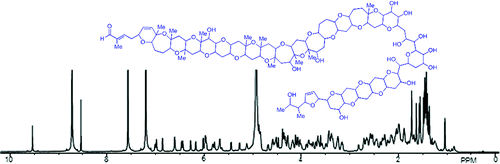
Et voilà! Say hello to brevisulcenal-F, their first solved structure from the algal cells. This toxin, tipping the scales at 2076 amu (M + Na), sets a record in its own right: it has seventeen contiguous 6- and 7-membered rings, A-Q, the most yet identified in a single marine ladder toxin (I can almost hear Mori, Nicolaou, Hirama, and Crimmins sharpening their swords, ready for action!).
Brevisulcenal-F spectrum and structure overlay
Source: JACS and M. Satake, U. of Tokyo


But how big is big? This new natural product certainly contends, but still doesn't approach two of the 850-lb gorillas in the room: palytoxin (PTX) and maitotoxin (MTX). First synthesized from PTX-COOH by Kishi in 1994, palytoxin, a soft-coral isolate from Hawaii, weighs in at 2680 amu. Although not specifically a ladder polyether, it was for decades considered the largest known non-peptide natural product. But PTX pales still in comparison to the largest known non-peptide np, maitotoxin, which totals 3422 amu, with 32 total ether rings. Isolated from Tahitian fish in 1976, maitotoxin eluded full structural characterization until the mid-1990s.
I'm glad my NMRs don't look like maitotoxin.
Source: Murata, JACS 1994


Where are these huge marine toxins coming from, exactly? Nakanishi advanced a polyepoxide cascade theory as early as 1985, which suggested that long, polyunsaturated terpenes (olefin biopolymers) were being somehow oxidized by the microorganisms, then cyclized into long ether "ladders," like a falling stack of dominos. It took another 20 years for experimental confirmation, but new cascade research by Jamison and others has shown that this might indeed be the case. 

Tuesday, February 28, 2012

The 2011 Organometallics Roundtable – Peering into the Future

(Note: I’m publishing this post concurrently with my blog bud Chemjobber. Hop on over to his site to read about the industry / academia training and #chemjobs angles. This way, regular readers get twice the opinions for half the price!)

Who wants to chat?
Source: Texas A&M U.
As 2011 drew to a close, John Gladysz, the new Chief Editor of Organometallics, sat down for a chat with seventeen organometallic chemists from different national (German, Swiss, Australian, US, Chinese, British) and employment backgrounds (14 academia, 2 industrial, 1 government). The result?  An in-depth discussion, full of banter and back-talk, which covers topics such as industrial training for grad students, national creativity differences, “dream reactions,” and how to encourage industrial cross-collaboration.

As an icebreaker, Gladysz had each chemist dream up their “Christmas Stocking Reaction,” the ultimate goal each would love to see realized. Here’s a quick rundown:

-      Pragmatism –Joachim Ritter (DuPont) envisioned several scenarios for taking non-petroleum-derived feedstocks on to commodity chemicals. Ritter’s focus on hydroxymethyl-furfural (HMF, a darling of ChemEng labs across the country) was perhaps unsurprising, but I enjoyed his new ideas for deoxygenation of vegetable oils to produce fine chemicals. Jerzy Klosin (Dow) chimed in for development of newer, cheaper catalytic complexes, especially championing first-row analogues for replacement of palladium in polymerizations. Bernhard Rieger (Technische U. Munschen) weighed in on incorporation of CO2 into polymers with nickel catalysts.

-     Break the Glove Boxes! – Jim Mayer (U. Washington) and Bill Jones (U. Rochester), building off of Ritter’s theoretical deoxygenation catalysts, proposed chemistry based on high-oxidation-state metals. Mark Humphrey (Australia National) wished for an air-insensitive route to Sonogoshira-type couplings of alkynyl dendrimers. Jennifer Schomaker (U. Wisc.-Madison) hoped to use nitrous oxide as a terminal oxidant, and Vy Dong (U. of Toronto) would like chiral ligands for high-valent Pd chemistry.

P-N-N pincers and Pd oxidation,
Z-metathesis and dehydrogenation,
Iridium cat'lysts that stitch up new rings
These are a few of their favorite things...
-      Crank up the Heat – Tobin Marks (Northwestern U.) wanted to see more ligand classes (think pincers and porphyrins) capable of supporting homogeneous catalysis at higher temperatures.

-      Mind your MOFs – Still others, such as Zach Ball (Rice U.) and Ekkehardt Hahn (Westfalische Wilhelms-Universitat Munster) weighed in on new types of building blocks and metals for cluster and MOF chemistry. Vivian Yam (U. of Hong Kong) wrapped up everyone’s requests with a nice bow; she hoped for new air- and moisture-insensitive OLED materials, solar energy-collecting polymers, and water-splitting photocatalysts.

Filling the “Tool Box” - Rieger cautioned to watch out for the recurring industrial opinion that “all the useful chemistry is already discovered.” Gladysz used the example of frustrated Lewis pairs, which, while a fairly young concept, are already turning heads. Bill Jones gave an impromptu one-liner about heterolytic hydrogenation: “If someone had written that on an exam…you’d give them a zero (back in the old days).” Humphrey chimed in on bimetallic bases, and Klosin for Ziegler-Natta studies.

But just then, Ritter poured cold water on the party: “Today’s chemical companies are busy reacting to rapid market swings and trends, which does not leave a lot of room for risky long-term projects.” Sensing, perhaps, that he’d deflated the roundtable’s enthusiasm, he quickly backtracked and mentioned that he’s “looking forward to…CO2 utilization, solar energy, and biomass based energy and chemicals.”

So there you go, future faculty members, he’s written half your proposal already!

Throwaway lines – CJ has collected quite a few of these, but I’d like to comment on a few more.

 “I’ve talked to a colleague in China whose professor advised ‘If you don’t do palladium chemistry, how will people know you are my student?’.” –Vy Dong

Peering into the OM "xstal ball "
Source: Organometallics
This issue seems to rankle most with the faculty, who toe the fine line between capitalizing on their past successes and striking out with their own programs. Suzanne Blum (UC-Irvine) cautioned against what she calls “n+1 research,” clinging to well-trodden paths while writing funding proposals. But Yam and Humphrey pointed out that initial funding in their home countries (China, Australia) can be tough unless you stick to the script.

This creativity discussion wound through the group, until Yam and Hahn debated whether Indian and Chinese universities still seemed to hire based on quantity (i.e. papers published) vs. quality.

Hahn: “…even the 28-year old researchers from China know their h-indexes [and] introduce themselves saying their name and ‘I have an h-index of 10.’ And you wonder who has trained them?”

I can’t say that I’ve never encountered the "publish or die" sentiment, but I had hoped it was becoming less prevalent with time. Readers, your thoughts?

The Last Word - …in my opinion, the chemical community performs poorly in transmitting to the general public what they are actually doing.” –Ekke relays a sobering thought for those of us in the blogosphere who toil daily to demystify our science.

Maybe he doesn’t read enough good science blogs?

Monday, February 27, 2012

Found Chemistry - Landmark Gate with Chemical Message

On a recent visit to a major US university, I had occasion to stop outside the towering steel gates leading into the main courtyard of the newly-constructed chemistry building. I glanced up, and saw organic molecules, decked out in bronze, blue, and red.


On either side of the gate are polypeptides, four residues each, that use standard amino acid abbreviations to spell out a four-letter word* on either side. Pictured (at left) is the left-hand gate. 


Here are artistic molecules done right - correct bond angles, color-coded atoms, even double bonds! They're certainly better rendered than most of the recent ChemBark "WWWTP?" posts.


*(Need a hint? Only so many schools have four-letter names!)